How fast can a Komodo dragon run? Faster than most people expect from a lizard that spends much of the day lying still in the shade. In short bursts, a Komodo dragon can reach about 16 to 20 kilometres per hour, according to the Smithsonian’s National Zoo, quick enough to surprise a deer at the edge of a forest. But its real weapons are patience, stealth and a venomous bite, not endurance. This guide explains how fast Komodo dragons run, how they move, why their sprints are short, how they hunt, swim and climb, and how the rangers keep visitors safe on the walks.
In short
- A Komodo dragon can briefly run at up to about 20 km/h, according to the Smithsonian.
- Its normal walking speed is about 4.8 km/h, close to a person’s, according to the San Diego Zoo Wildlife Alliance.
- The sprints are short: dragons hunt by ambush, not by long chases.
- They are also good swimmers, and the young are skilled climbers.
How fast can a Komodo dragon run? The short answer
The Smithsonian’s National Zoo says that Komodo dragons can briefly reach speeds of 10 to 13 miles per hour, or about 16 to 20 kilometres per hour. The San Diego Zoo Wildlife Alliance gives a running speed of 14 to 18.5 kilometres per hour, for short distances only. The figures overlap, and they agree on the key point: a dragon is fast for a few seconds, not for long.
That speed is remarkable for an animal that can weigh 70 kilograms or more. Most of the time, though, a dragon moves slowly and deliberately, walking at about the pace of a person, or not moving at all. The bursts of speed are kept for the moments that matter: an attack on prey, a fight with another dragon or an escape.
Komodo dragon speed at a glance
| Movement | Figure | Source |
|---|---|---|
| Walking | About 4.8 km/h | San Diego Zoo Wildlife Alliance |
| Running, short distances | 14 to 18.5 km/h | San Diego Zoo Wildlife Alliance |
| Top speed, briefly | 16 to 20 km/h | Smithsonian’s National Zoo |
| Distance walked per day | About 2 km on average, up to 10 km | San Diego Zoo Wildlife Alliance |
| Longest known swim | At least 450 m, between Komodo and Nusa Mbarapu | San Diego Zoo Wildlife Alliance |
These are figures for healthy adults in good conditions. A young dragon moves differently from a heavy old male, and every dragon is slower in the cool of the early morning than in the heat of the day, when its body is warm.
How a Komodo dragon runs
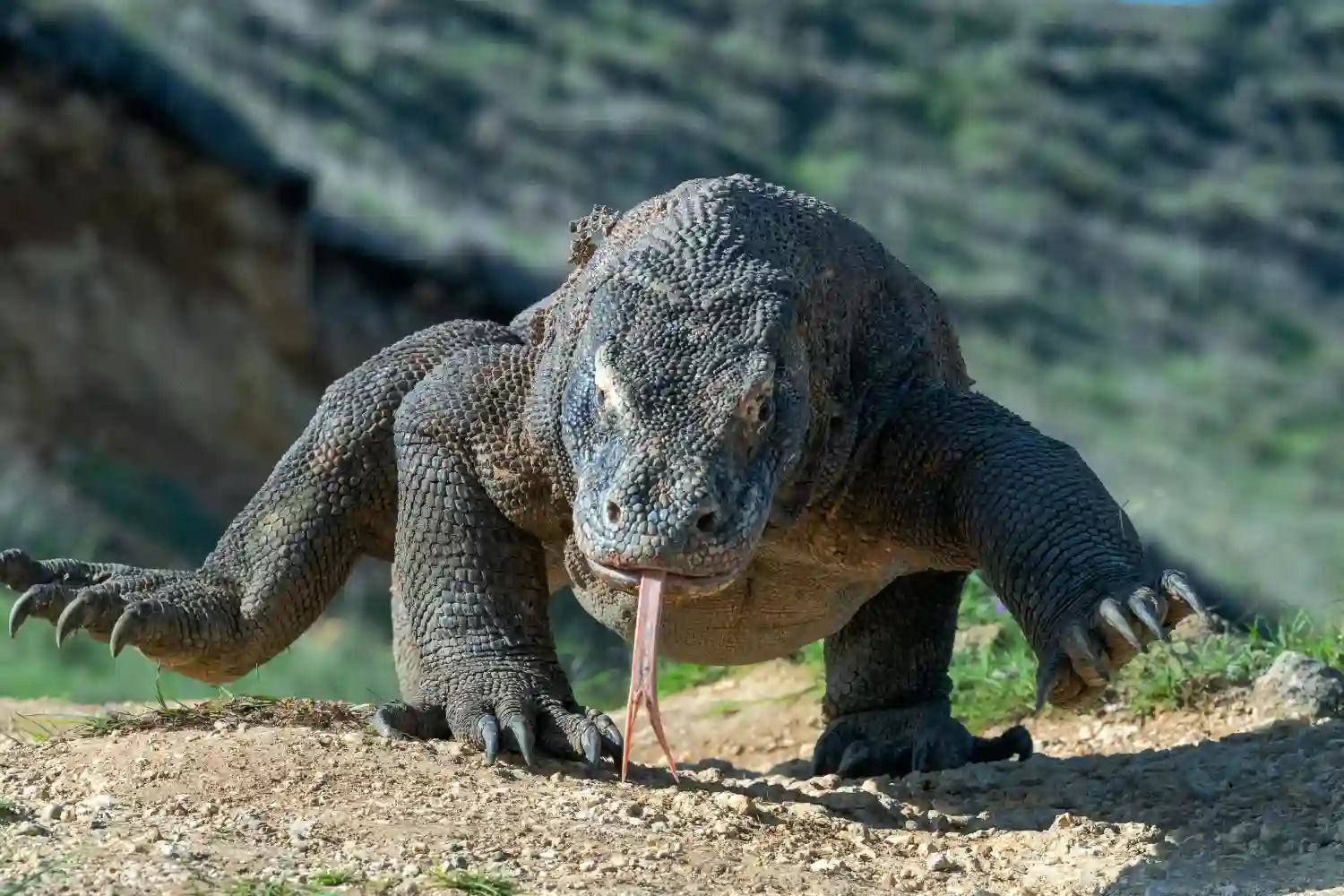
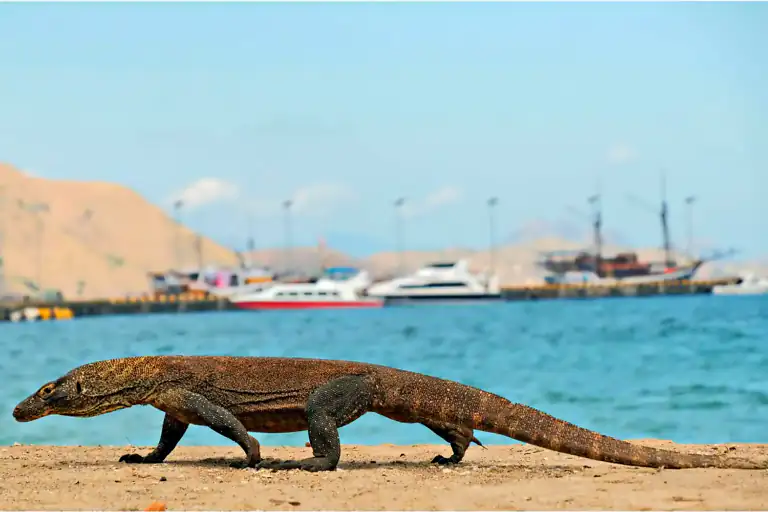
A walking dragon sways. Its body, head and tail undulate from side to side with each step, the classic rolling walk of a big lizard. When it runs, everything changes: according to the San Diego Zoo Wildlife Alliance, the body and tail are held fairly rigid, the hind feet swing out in a wide arc to the side, and the tail is raised off the ground.
The legs are short and powerful, set out to the sides of the body, with strong claws that grip the ground. It is not the long-legged stride of a deer or a dog, but over a short distance it is surprisingly effective, especially from a standing start in the grass or at the edge of the forest.

Why the bursts are short
Komodo dragons are reptiles, and reptiles are built for short efforts rather than long chases. They warm up in the sun rather than burning food to stay warm, which lets them survive on far less food than a mammal of the same size, but it also means they tire quickly when they push hard. A dragon can sprint, but it cannot keep running like a dog or a horse.
Temperature matters too. According to the San Diego Zoo Wildlife Alliance, a dragon’s body can cool to around 20 degrees Celsius at night and rise above 40 degrees in the day, and larger dragons heat up and cool down more slowly than smaller ones. A dragon is at its quickest when its body is warm, which is why they spend the mornings basking before they become active.
Size plays a part as well. A big, heavy adult has more power but also more weight to move, and it relies more on surprise than on speed. That is why the speed of a Komodo dragon is best understood as part of a hunting strategy, not as a sporting record.
Energy is precious on a dry island. A dragon that eats a large meal may not need to hunt again for days, and wasting energy on long, failed chases would make no sense. Short, well-timed bursts, followed by long rests in the shade, are exactly what an animal of its size and lifestyle needs to survive.
Speed, stealth and the hunt
Komodo dragons do not chase their prey across the islands. The Smithsonian describes a hunting strategy based on stealth and power: a dragon can spend hours in one spot along a game trail, waiting for a deer or a pig to come close. Then it lunges with a short burst of speed and a powerful bite.
The bite does the rest. Komodo dragons have serrated teeth and venom glands, and an animal that escapes after a bite often weakens and is followed by the dragon, which tracks it with its forked tongue. Our articles on whether Komodo dragons are venomous and on what Komodo dragons eat explain the hunt in detail.
Not every dragon hunts the same way. The San Diego Zoo Wildlife Alliance notes that medium-sized dragons forage actively, while the largest ones tend to sit and wait for prey, citing a study by Harlow and colleagues from 2010. Either way, speed is only one tool among several, and rarely the most important one.
Deer, the main large prey on the islands, can easily outrun a dragon over any real distance. That is exactly why the dragon does not try. It waits beside the game trails that deer use and relies on the first few metres of its rush, when its speed and its bite matter most.
Swimming between islands
Komodo dragons are good swimmers, like most monitor lizards. They fold their legs against their body and drive themselves forward with their powerful tail, and diving underwater can be an effective escape. The longest known swim, according to the San Diego Zoo Wildlife Alliance, was at least 450 metres, between Komodo Island and the small island of Nusa Mbarapu.
Swimming is slower than running, but it is a useful skill on islands surrounded by the sea. A dragon can cross a channel, follow the shore or escape into the water, and the beaches are part of its territory, where carrion washes up and the sea breeze keeps it cool.
That does not mean dragons travel freely between the islands. They show strong ties to their home ground and rarely leave the valleys where they were born, according to a study by Jessop and colleagues from 2018, cited by the same source. Seeing a dragon walk along a beach, as many visitors do on Komodo and Rinca, is a reminder that the sea is part of their world too.

Climbing: a skill of the young
Young Komodo dragons are agile climbers. Hatchlings and juveniles climb trees, and only the very young are light enough to jump from branch to branch, according to the San Diego Zoo Wildlife Alliance. In the trees, they are safe from the adults, which eat smaller dragons and are too heavy to follow them.
As they grow heavier, dragons lose the ability to climb and spend their lives on the ground. Our guide to the baby Komodo dragon explains why the young live in the trees and how they grow up.
A day in the life of a Komodo dragon
Komodo dragons are active by day. According to the San Diego Zoo Wildlife Alliance, they usually wake around 6:00 to 6:30, bask in the sun for much of the morning, and are most active around 9:30 and again around 15:30, seeking shade in the hottest hours. They sleep for about 12 hours, in burrows, natural hollows or under overhanging plants.
Each dragon has a home range, with a core area for shelter and basking and a larger area where it forages and scavenges, according to the San Diego Zoo Wildlife Alliance. A large adult’s range can cover several square kilometres, and dragons have excellent homing and navigation skills, finding their way back to familiar places across the hills and valleys of their island.
A dragon walks about two kilometres a day on average, and adults can cover up to ten kilometres, according to the same source. For visitors, that rhythm explains a lot: on a morning ranger walk, you often see dragons resting or slowly warming up, and the chance of seeing one on the move grows as the day warms.

Myths about Komodo dragon speed
- “Komodo dragons are slow and lazy.” They rest a lot, but they can sprint at up to about 20 km/h when it matters.
- “They chase their prey for miles.” No. They hunt by ambush, with a short rush from close range, and then follow wounded prey slowly by scent.
- “A big dragon is a fast dragon.” Not necessarily. The largest dragons tend to sit and wait, while medium-sized ones forage more actively.
- “They cannot swim.” They swim well, and the longest known swim was at least 450 metres.
- “They are fastest in the morning.” The opposite: a dragon needs to warm up in the sun first, so it is quickest when its body is warm.
The truth is more interesting than the myths. A Komodo dragon’s speed is a tool it uses rarely and precisely, which is why so many visitors are surprised when they learn how fast the sleepy lizard by the path can really move.
Could you outrun a Komodo dragon?
On paper, a fit person sprinting on a flat track can run faster than a Komodo dragon’s top speed. In the real world, that comparison is meaningless. The ground on Komodo and Rinca is rough, with rocks, roots and loose earth, the heat is intense, and a dragon attacks from a few metres away, not from a starting line. Nobody should ever test it.
The safe answer is the one the rangers follow: never get close enough for speed to matter. Visitors on the ranger walks keep several metres away from any dragon, even one that looks fast asleep, and the rangers decide how close the group goes. Our guide to whether Komodo National Park is safe explains the rules.
Watching dragons move on a ranger walk
Most dragons you see on a ranger walk are resting, basking or walking slowly along the trail, and that is already a thrilling sight. Watch how a dragon moves: the side-to-side sway of the walk, the long tail dragging behind, the head swinging as the forked tongue tastes the air. Seeing a dragon speed up is rare, and when it happens, the rangers will move the group back.
For photos, a zoom lens or a phone with a good zoom lets you fill the frame from a safe distance. Stay where the ranger tells you, keep your eyes on the dragon rather than on your screen, and never step closer for a better shot. Our Komodo photography guide has tips for photographing the dragons safely.
How the rangers keep visitors safe
Every visit to see the dragons on Komodo and Rinca is led by park rangers, who know the animals and the trails. They carry a long forked stick to keep a curious dragon at a distance, and they tell the group where to stand and when to move on. Following their instructions is the single most important rule of the walk.
- Stay with the group and behind the ranger at all times.
- Keep several metres away from any dragon, even one that looks asleep.
- Move calmly; never run, shout or make sudden movements near a dragon.
- Never feed or touch a dragon, and keep food in your bag.
- Tell the ranger if you have a wound, as dragons are drawn by the smell of blood.
Our guides to Komodo Island and Rinca Island describe the walks and what to expect.

Our view
How fast can a Komodo dragon run? Fast enough, for a few seconds, to catch a deer that wanders too close, and that is all it needs. The rest of the time, the largest lizard on Earth relies on patience, stealth and a venomous bite. Seeing one on a ranger walk, from a safe distance, is one of the great wildlife moments in Asia, in a park that has been a UNESCO World Heritage Site since 1991.
A Komodo dragon does not need to be the fastest animal on its island. It only needs to be the most patient.
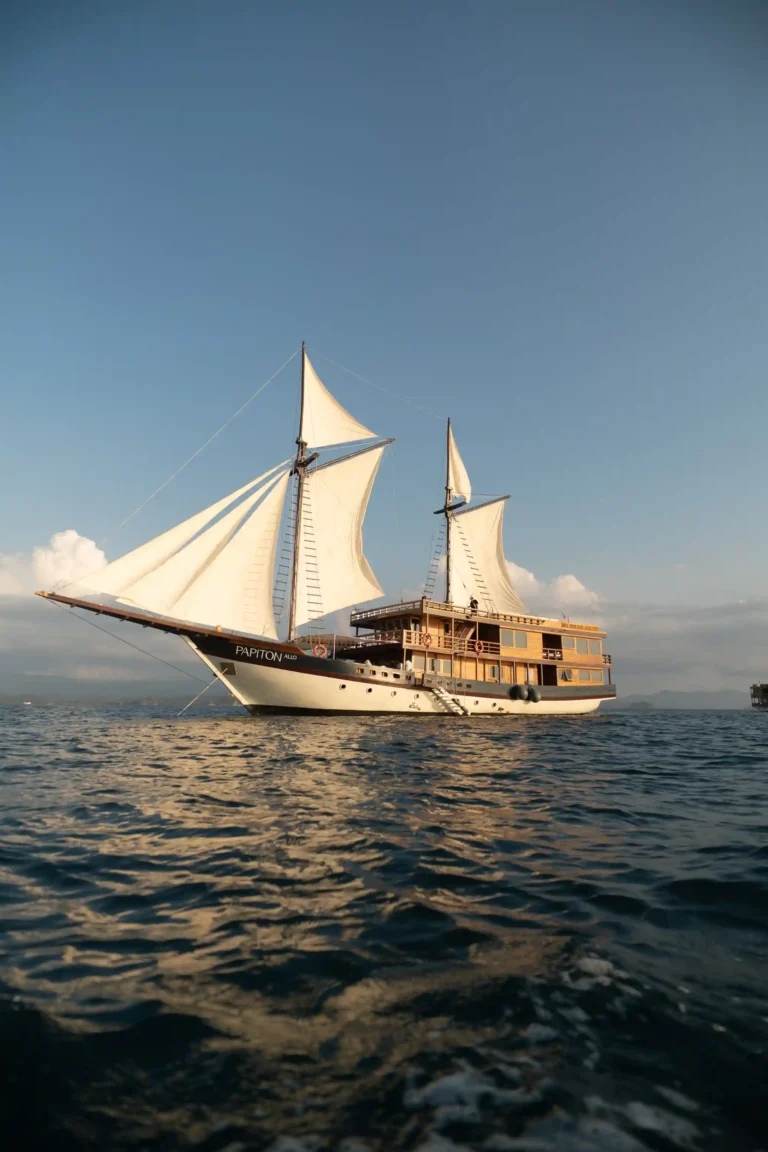
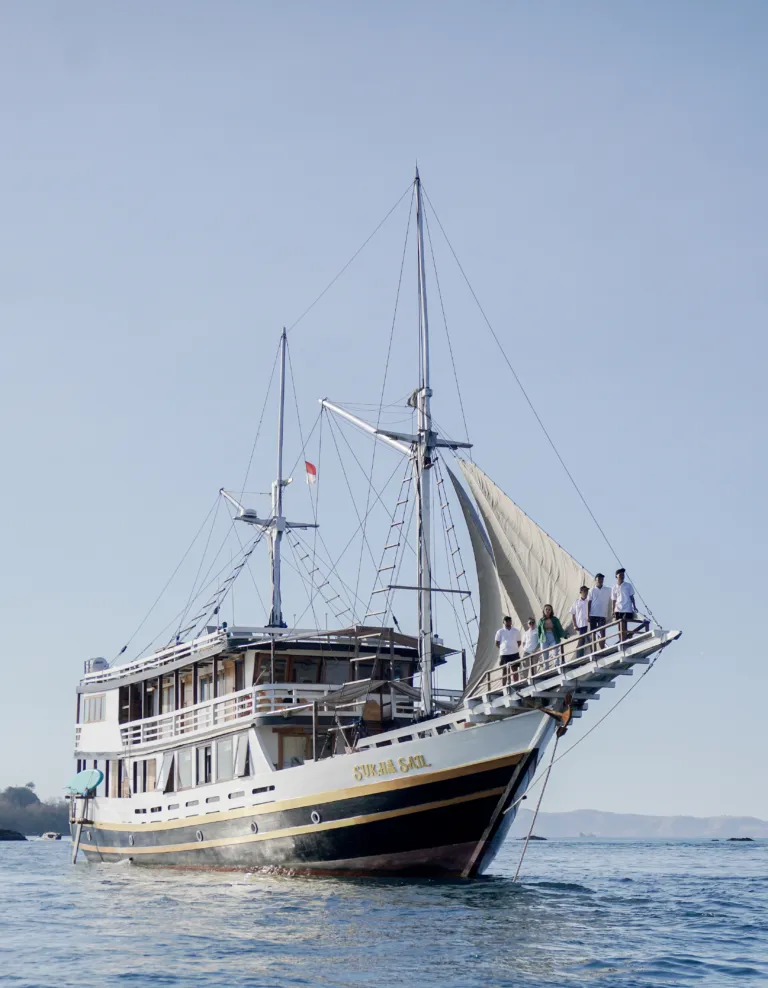
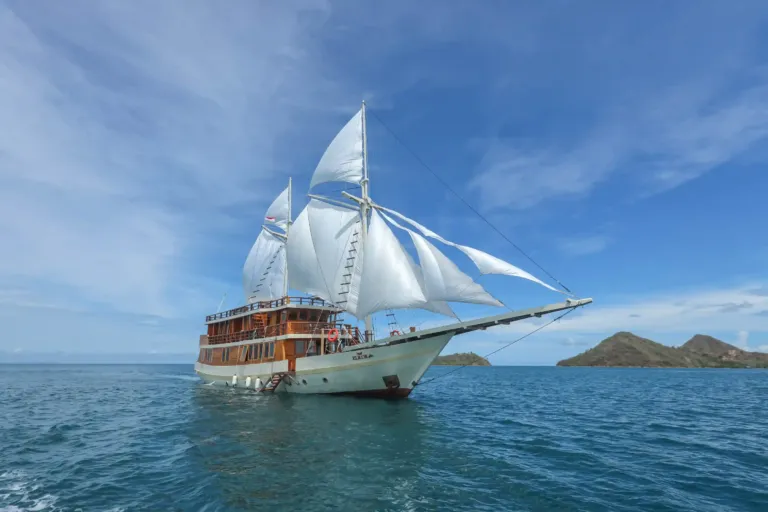
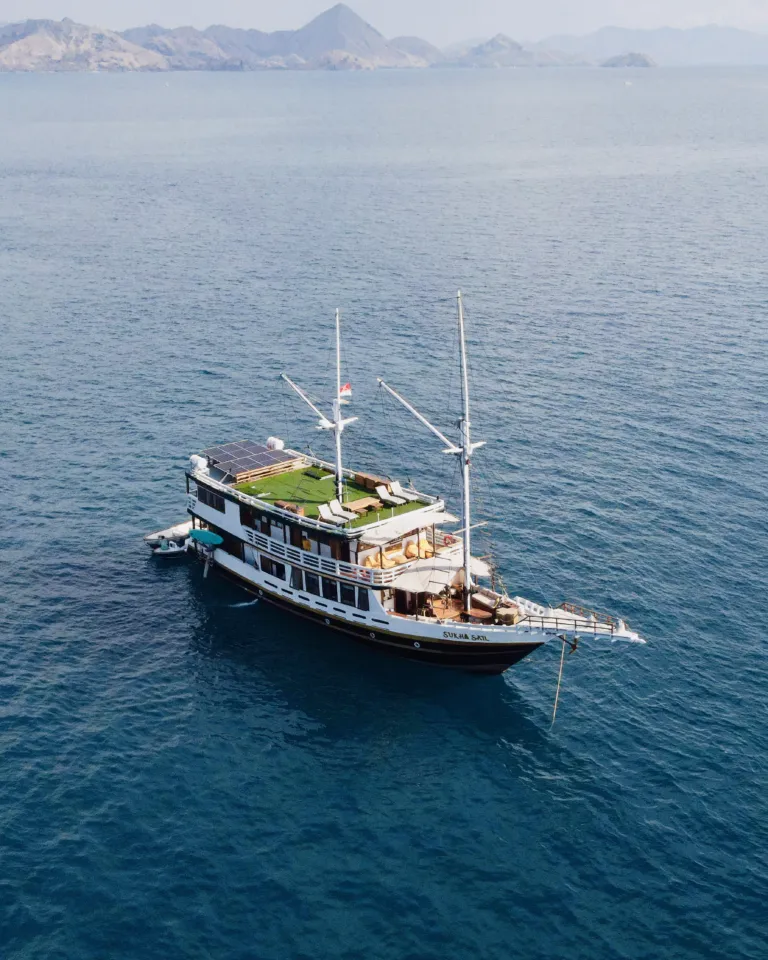
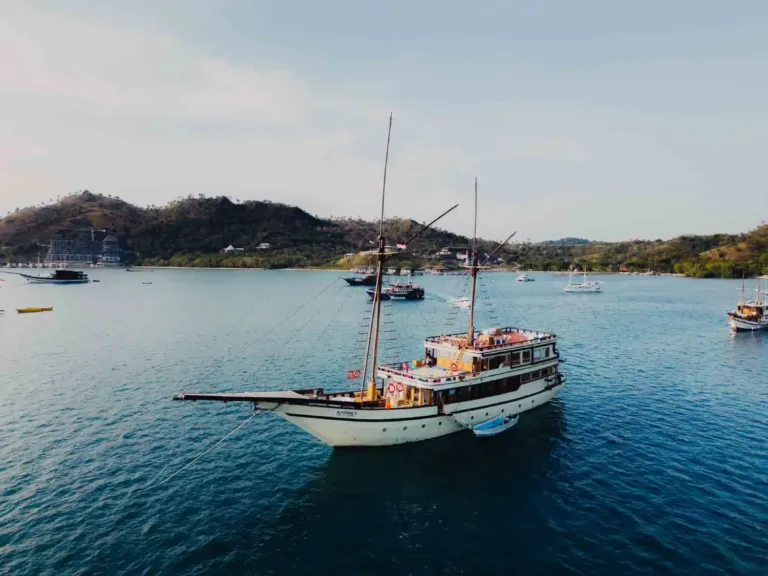
Want to see them for yourself? Most liveaboard trips include a ranger walk on Komodo or Rinca. Compare the sharing trips with live prices and departures, and read more in our guide to the Komodo dragons.
Questions
How fast can a Komodo dragon run?
Briefly up to about 16 to 20 km/h, according to the Smithsonian’s National Zoo, and only over short distances.
How fast does a Komodo dragon walk?
About 4.8 km/h, close to the walking pace of a person, according to the San Diego Zoo Wildlife Alliance.
Can a Komodo dragon outrun a human?
Over a few metres on rough ground, it can catch someone off guard. That is why visitors keep their distance and follow the rangers.
Can Komodo dragons swim?
Yes. They are good swimmers, and the longest known swim was at least 450 metres between Komodo and Nusa Mbarapu.
Can Komodo dragons climb trees?
The young can, and they live in the trees to avoid the adults. Adults are too heavy to climb.
When are Komodo dragons most active?
In the day, with peaks around 9:30 and 15:30, after basking in the morning sun, according to the San Diego Zoo Wildlife Alliance.
How do Komodo dragons catch fast prey like deer?
By ambush: they wait along game trails, lunge with a short burst of speed and rely on a powerful, venomous bite.
How far does a Komodo dragon walk in a day?
About two kilometres on average, and adults can cover up to ten, according to the San Diego Zoo Wildlife Alliance.
Do Komodo dragons stand on their hind legs?
Males sometimes wrestle standing up on their hind legs when they fight. When they run, they move on all four legs, with the tail raised.
Are Komodo dragons dangerous to people?
They can be, which is why every walk is led by rangers. Keep your distance, stay with the group and follow the rangers’ instructions.



 Elbark Cruise
 Papiton Allo
 Semesta Voyages
 Sukha Sail 1