
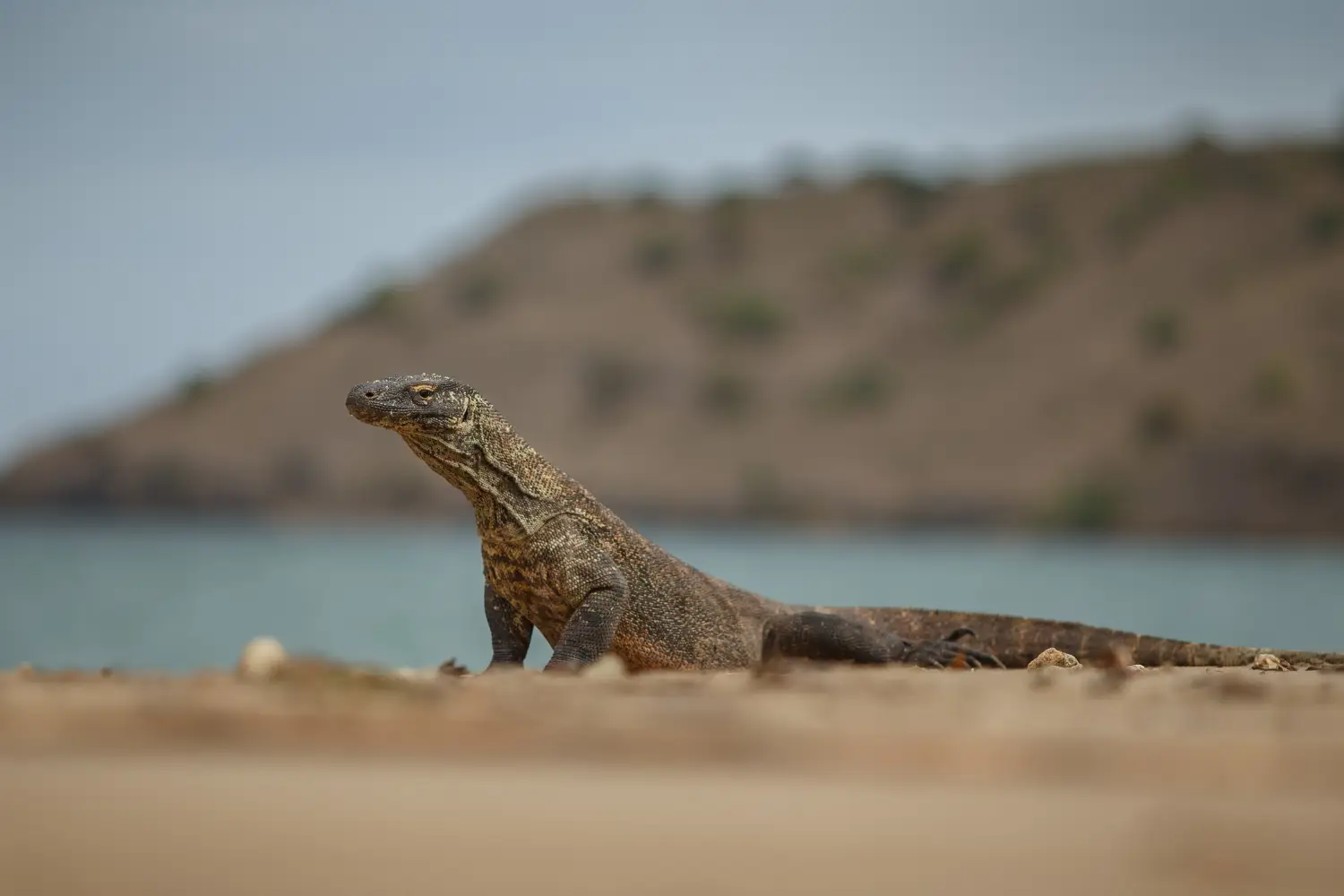
What do Komodo dragons eat? Almost any kind of meat they can catch or find. The largest lizards on Earth are top predators on their islands, hunting deer, wild boar and even water buffalo, and they are just as happy to eat an animal that is already dead. Young dragons start much smaller, with insects and lizards in the trees. This guide explains the diet of the Komodo dragon from hatchling to adult, how it hunts, how much it can eat in one meal and what that means when you see one on a ranger walk.
In short
- Komodo dragons are carnivores: adults eat almost any kind of meat, from deer and wild boar to water buffalo.
- They also eat carrion, and can smell rotting meat up to about 4 kilometres away.
- A dragon can eat up to 80% of its own body weight in a single meal.
- Young dragons live in trees and eat insects, small lizards, snakes and birds, partly to stay away from hungry adults.
What do Komodo dragons eat? The diet at a glance
The Komodo dragon is a meat eater all its life, but what it eats changes as it grows. According to the Smithsonian’s National Zoo, adults eat almost any kind of meat, both by scavenging and by stalking prey, while the young feed mainly on small lizards and insects, as well as snakes and birds. The table below sums up the stages.
| Stage | Where it lives | What it eats |
|---|---|---|
| Hatchling and young | Mostly in trees | Insects, small lizards, snakes, birds |
| Growing dragon, from about 5 years | On the ground | Larger prey, about 25 kg in body weight at this age |
| Adult | Forest, savanna and beaches | Deer, wild boar, water buffalo, carrion and smaller dragons |
What they do not eat is just as clear. Komodo dragons do not eat plants, and they are not picky about freshness: a dead animal on the beach is as welcome as a deer on the trail. That flexibility is one of the reasons they have survived on small, dry islands where food can be scarce.
The main prey: deer, wild boar and water buffalo
On Komodo and Rinca, the most important prey of adult dragons are Timor deer, wild boar and water buffalo. Deer and boar are common on the islands, and a fully grown dragon can take an animal much heavier than itself. Water buffalo are the biggest prey of all, and a bite from a dragon can bring down even an animal of several hundred kilograms over time.
These are the animals you often see on a ranger walk, too: deer grazing at the edge of the forest, a wild boar crossing the path, buffalo at a waterhole. The dragons and their prey share the same dry forest and savanna, and the balance between them is one of the reasons the islands are protected. Our guide to the Komodo dragons describes their islands and how to see them.
Smaller animals are on the menu too. Adult dragons will also take birds, rodents and other lizards when the chance comes. In short, the bigger and slower the animal, the more interesting it is to a hungry adult, and the smaller the dragon, the smaller its prey.
Carrion: a nose for rotting meat
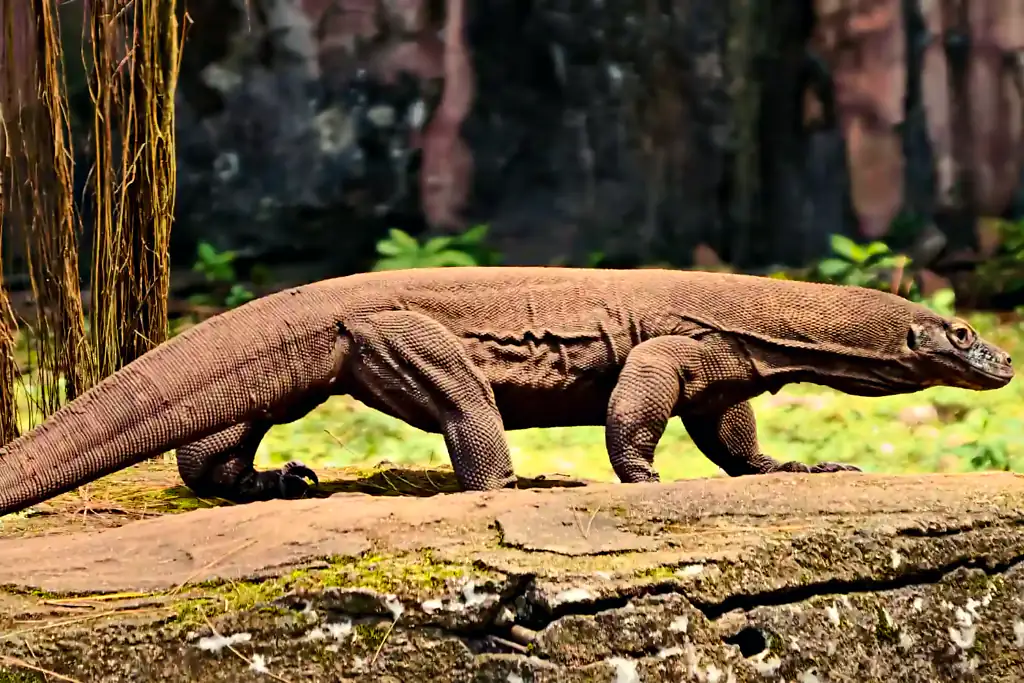
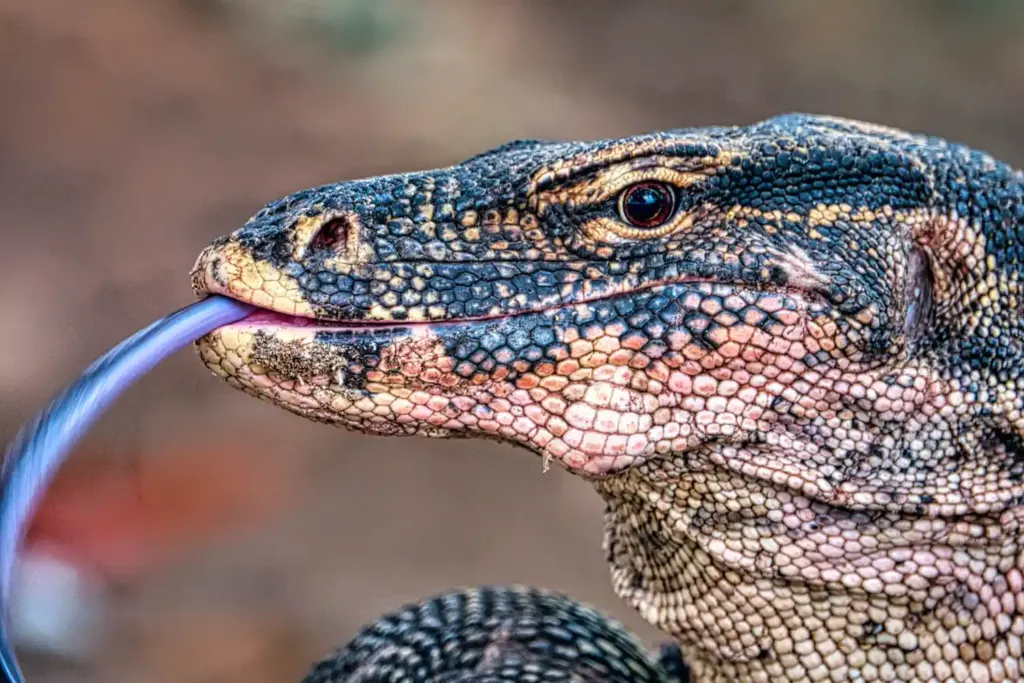
Komodo dragons are hunters, but they are also expert scavengers. The Smithsonian notes that they can smell carrion, or rotting flesh, up to 4 kilometres away. They do not smell with their nose alone: the long, yellow, forked tongue flicks in and out, collects scent from the air and the ground, and carries it to a sense organ in the roof of the mouth that reads it.
That is why several dragons often gather at the same carcass. A dead deer or buffalo can attract dragons from far around, and the largest ones eat first. For an animal that may go a long time between kills, a free meal is too good to miss, and nothing goes to waste.
Scavenging also explains why dragons are often seen near beaches and the edges of villages. A dead animal on the shore, or the remains left after a hunt by another dragon, is an easy meal, and a dragon that finds one early gets the best of it.
How a Komodo dragon hunts
A Komodo dragon is not a chaser. It is an ambush hunter: it can spend hours in one spot along a game trail, perfectly still, until a deer or a boar comes close enough. Then it launches a short, fast attack. Over a short distance, a dragon can briefly reach 16 to 20 kilometres an hour.
The bite does the rest. A dragon’s teeth are serrated, like a steak knife, and it bites and pulls back with its powerful neck and body, opening deep wounds. Venom from glands in the lower jaw stops the blood from clotting and lowers the blood pressure, so even an animal that escapes grows weak. The dragon may simply follow it, slowly, until it falls, using its tongue to track the scent of the wounded animal through the forest. Other dragons, drawn by the same smell, often join the meal. Our article on whether Komodo dragons are venomous explains what scientists found.
Even the teeth are built for this way of eating. In 2024, researchers writing in Nature Ecology & Evolution reported that the cutting edges and tips of Komodo dragon teeth are coated with iron, which helps keep them sharp. Dragons also lose and replace their teeth throughout their lives, so a dragon always has a full set of blades for its next meal.
How much can a Komodo dragon eat?
A lot, and very fast. The Smithsonian notes that a Komodo dragon can eat up to 80% of its own body weight in a single meal. For a large adult of about 70 kilograms, that is a meal of more than 50 kilograms. Dragons tear off large pieces of meat and swallow them whole, rather than chewing, and they eat bones, hooves and skin as well.
After a big meal, a dragon slows right down. It finds a sunny or shady spot, depending on the heat of the day, and rests for a long time while it digests. That is one reason why the dragons you see on a ranger walk are often lying still: a full dragon has no reason to move.
How often do Komodo dragons eat?
There is no fixed schedule. A Komodo dragon is a reptile, and like other reptiles it needs far less food than a mammal of the same size, because it does not use energy to keep its body warm. Instead, it warms up in the sun and cools down in the shade, and it saves its energy for the moments that matter.
That is what makes the huge meals possible. A dragon that has eaten a large part of a deer can go a long time before it needs to hunt again, while a smaller or younger dragon eats smaller meals more often. Scientists are still learning how long dragons can go between meals in the wild, but the pattern is clear: feast, rest, digest, and wait for the next opportunity.
What young Komodo dragons eat
A Komodo dragon starts life very small. Hatchlings weigh less than 100 grams and are about 40 centimetres long, and for their first years they live mostly in trees. The San Diego Zoo Wildlife Alliance notes that young Komodo dragons live in trees and eat insects, and the Smithsonian adds small lizards, snakes and birds to the list.
Life in the trees has a second purpose: safety. Adult dragons are too heavy to climb, and they are known to eat younger dragons, so staying off the ground keeps the young out of reach. As they grow, they come down to hunt on the ground, and by about 5 years old, at around 25 kilograms, they begin to take larger prey.
Their start in life is a long one. A female lays about 30 eggs, often in a hole on a hillside or in the old nest mound of a megapode bird such as the orange-footed scrubfowl, and the eggs incubate for about nine months. When the young hatch, they are on their own from the first day, and the first thing they do is find a tree.
Do Komodo dragons eat each other?
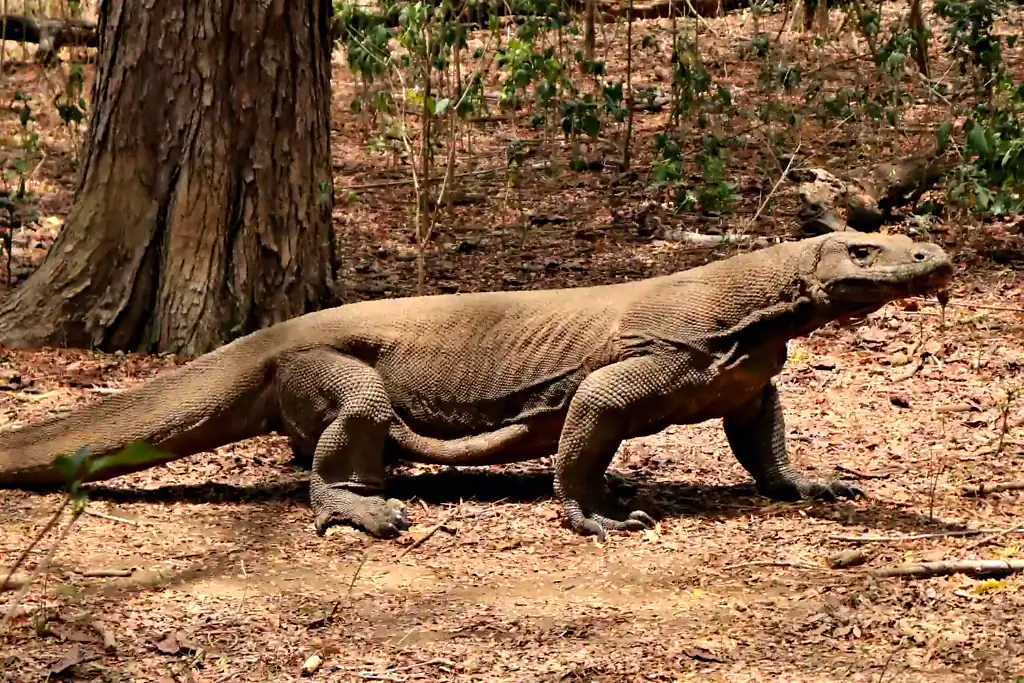
Yes. Komodo dragons are cannibalistic, and adults will eat smaller dragons when they get the chance. It sounds brutal, but on small islands where food can be scarce, it is part of how the population stays in balance.
The young have clever ways to avoid becoming a meal. Besides living in trees, they often roll in fecal material, which gives them a scent that larger dragons avoid. At a carcass, the biggest dragons eat first, and smaller ones wait their turn or keep their distance, because a fight over food with a larger dragon can end badly.

Komodo dragon diet: myths and facts
Few animals have as many stories told about them as the Komodo dragon. Here are some of the most common ones about what they eat, and what is actually true:
| Myth | Fact |
|---|---|
| Dragons only eat animals they kill. | They eat carrion too, and can smell it up to about 4 km away. |
| Dragons chase their prey over long distances. | They are ambush hunters that wait along game trails and strike over a short distance. |
| Bacteria in the mouth kill the prey. | Scientists found venom glands in the jaw; the venom stops the blood from clotting. |
| Dragons need to eat every day. | As reptiles, they need far less food and can eat huge meals, then rest for a long time. |
| Dragons often hunt people. | People are not part of their normal diet, and attacks are rare. |
Do Komodo dragons eat people?
People are not part of a Komodo dragon’s normal diet, and attacks are rare. They do happen, mostly to villagers or park staff in close contact with the animals every day, which is why every walk on the dragon islands is led by a park ranger. The rangers know the animals, carry a long forked stick to keep a curious dragon at a distance and decide how close the group can go.
The rules are simple: stay with the group and behind the ranger, keep several metres away even from a dragon that looks asleep, never feed or touch one, and move calmly. Follow them, and the walk is safe and unforgettable. Because dragons have such a keen sense of smell, tell the ranger discreetly before the walk if you have an open wound or are menstruating; it is a normal question for them. Our guide to whether Komodo National Park is safe covers the other risks of a trip.
Will you see a dragon eating?
Probably not, and that is a good thing. Hunts happen when no one is watching, often early in the morning or late in the day, and a kill can take a long time. On a ranger walk, you are more likely to see dragons resting, walking slowly along a path or lying on a beach, which is exactly what a well-fed predator does most of the day.
If your group does come across dragons at a carcass, the ranger will keep everyone well back and may choose another path. Feeding dragons are focused, competitive and unpredictable, and the smell of a kill can draw more of them from the forest. It is a rare and memorable sight, but one to watch from a distance, with the ranger’s word as the rule.
Visitors must never feed the dragons, or any other animal in the park. Animals that learn to link people with food lose their natural fear, which is dangerous for visitors and for the animals themselves. Watch from a distance, use the zoom on your camera, and let the rangers tell you the stories of the hunts they have seen.
Why the dragons’ food matters for their future
A predator is only as healthy as its prey. The dragons depend on the deer, wild boar and water buffalo of their islands, and on the dry forest and savanna where those animals live. Protecting the dragons therefore means protecting the whole landscape, which is one of the reasons Komodo National Park was created in 1980.
In 2021, the IUCN moved the Komodo dragon from Vulnerable to Endangered on its Red List, mainly because rising temperatures and sea levels are expected to shrink its habitat, as NPR reported. Inside the park, the population is protected; outside it, on Flores, the dragons face the loss of their habitat and their prey.
Estimates of how many dragons are left vary. The San Diego Zoo Wildlife Alliance gives a wild population of about 3,500, while UNESCO’s description of the park mentions around 5,700. Either way, every dragon depends on healthy herds of deer, boar and buffalo, and on visitors who leave the animals and their food alone.

Our view
So, what do Komodo dragons eat? Almost anything made of meat, alive or dead, and in quantities that are hard to imagine. Knowing how they hunt and eat makes a ranger walk far more interesting: the still dragon on the trail is not lazy, it is waiting, or digesting. Komodo National Park has been a UNESCO World Heritage Site since 1991, and seeing these predators in their own home is one of the great wildlife experiences in Asia.
A Komodo dragon can wait for hours, smell a meal from kilometres away and eat most of its own weight in one sitting. Patience is its greatest weapon.
Want to see them for yourself? Most liveaboard trips include a ranger walk on Komodo or Rinca. Compare the sharing trips with live prices and departures.
Questions
What is a Komodo dragon’s favourite food?
Adults mostly eat deer, wild boar and water buffalo, plus any carrion they find. Young dragons eat insects, small lizards, snakes and birds.
How much does a Komodo dragon eat?
Up to 80% of its own body weight in a single meal, according to the Smithsonian’s National Zoo.
Do Komodo dragons eat plants?
No. They are carnivores and eat only animals, alive or dead.
How far away can they smell food?
Up to about 4 kilometres for carrion. The forked tongue collects the scent and carries it to a sense organ in the mouth.
Do Komodo dragons eat their young?
Adults will eat smaller dragons, which is why the young live in trees for their first years.
Can I watch the dragons being fed?
No. Visitors never feed the dragons, and the walks are about seeing them as they are in the wild, with a park ranger.
Can a Komodo dragon kill a water buffalo?
Yes. Water buffalo are the largest prey on the islands, and a bite from a dragon can bring one down over time as the wounds and the venom take effect.
Why are the dragons so still during the walk?
They may be digesting a meal, resting in the heat or waiting for prey. A still dragon is still a wild predator, so keep your distance.






 Elbark Cruise
 Papiton Allo
 Semesta Voyages
 Sukha Sail 1