

A baby Komodo dragon starts life as one of the most vulnerable animals on its island. It hatches from an egg that spent months buried in a hillside, weighs less than a bar of chocolate and has no parent to protect it, while the largest lizards on Earth roam the ground below. So it does the one thing the adults cannot do: it climbs. This guide explains how Komodo dragons nest, how long the eggs take, why the hatchlings live in the trees, what they eat, how they survive and grow, and the remarkable zoo dragons that were born without a father.
In short
- Females lay their eggs in July to early September, and the young hatch between February and May.
- A hatchling weighs less than 100 grams and measures about 40 centimetres, according to the Smithsonian.
- The young live in the trees, out of reach of the adults, which eat smaller dragons.
- In zoos, females have produced young without a male, and those young are always male.
Baby Komodo dragon facts at a glance
The figures below come from two of the most trusted sources on the species, the Smithsonian’s National Zoo and the San Diego Zoo Wildlife Alliance. Where they differ, both are shown:
| Stage | What happens |
|---|---|
| Mating | May to August (Smithsonian) |
| Nest digging | June to August (SDZWA) |
| Egg laying | One clutch a year, July to early September (SDZWA) |
| Clutch size | About 30 eggs (Smithsonian); 21 on average, from 1 to 30 (SDZWA) |
| Incubation | About nine months (Smithsonian); 2.5 to 8 months depending on temperature and moisture (SDZWA) |
| Hatching | February to May (SDZWA) |
| Hatchling size | Under 100 g and about 40 cm long (Smithsonian) |
| At five years | About 25 kg and 2 m long (Smithsonian) |
The differences are not mistakes. Incubation depends on the heat and the moisture of the soil, so it varies from nest to nest, and in zoos it is about 220 days, according to the San Diego Zoo Wildlife Alliance. Clutch sizes vary with the size and condition of the mother.
Mating and nest building
The story of a baby Komodo dragon begins in the middle of the dry season. Mating takes place between May and August, according to the Smithsonian, and the dominant males compete for females in ritual fights, wrestling on their hind legs. Courtship is rough by human standards: the male scratches and licks the female, and she may bite and slap him with her tail if he pushes too hard.
From June to August, the females dig their nests. Some dig into the soil of a hill slope, and others use the old nest mounds of megapodes, ground birds such as the orange-footed scrubfowl that build huge heaps of earth and leaves. The Smithsonian describes these mounds as up to a metre high and three metres across, and the rotting leaves inside keep the temperature steady.
The mounds are the favourite. On Komodo Island, a study led by Tim Jessop found that 61 percent of the dragons’ nests were in megapode mounds, with the rest split evenly between open hillsides and nests dug in the ground. Within the mounds, the females also chose by how much sun each one received.
A mother on guard
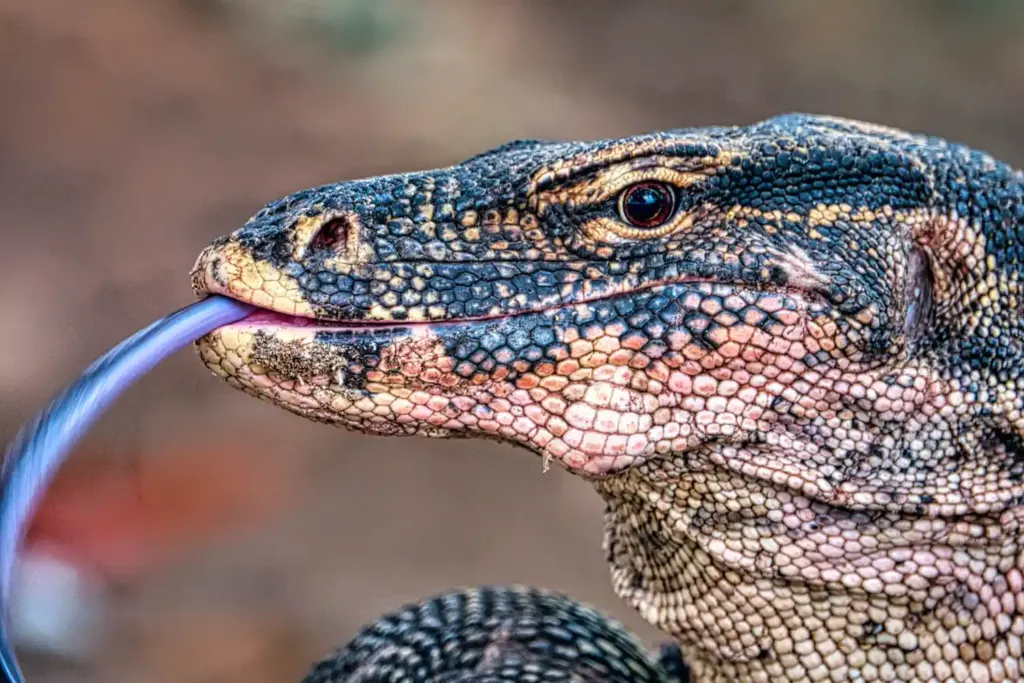
Most females lay one clutch of eggs a year, between July and early September, sometimes over several days. The eggs are about 10 centimetres long and 6 centimetres wide, with a soft, leathery shell, according to the San Diego Zoo Wildlife Alliance. Once they are buried, the mother does something unusual for a lizard: she stays.
The female guards the nest from about August to December, and the Smithsonian notes that she may lie on top of it to protect the eggs. An unguarded clutch would be an easy meal for any animal that found it, so these first months of watching are one of the few times in a Komodo dragon’s life when one animal looks after another.
The care stops there. When the eggs hatch, months later, the mother is long gone, and the Smithsonian notes that there is no parental care for the young. A baby Komodo dragon comes out of the ground alone, and from that moment it has to survive on its own wits.
Months in the ground
The eggs spend the rest of the dry season and the start of the wet season underground. The Smithsonian gives an incubation of about nine months, while the San Diego Zoo Wildlife Alliance gives 2.5 to 8 months, depending on the temperature and the moisture of the soil. Either way, it is a long wait, through the hottest and driest weeks of the year and the first heavy rains.
A long incubation is risky. Eggs can dry out, flood or be found by predators, and a nest in poor soil may fail completely. It is one of the reasons why Komodo dragons lay so many eggs: many will never hatch, and of those that do, only a small share of the young will survive their first years.
The timing may help the young. Hatching between February and May means they emerge towards the end of the wet season, when the forest is green and full of cover, and small prey is easier to find than in the long dry months. For a hunter the size of a pencil case, every advantage counts.
Hatching day
A hatchling uses a tiny, sharp egg tooth on the tip of its snout to cut through the leathery shell, then digs its way up through the soil. According to the Smithsonian, the hatchlings weigh less than 100 grams and average about 40 centimetres from nose to tail. The San Diego Zoo Wildlife Alliance gives an average hatching weight of about 80 grams.
Young dragons look quite different from their parents. Adults are grey or clay-coloured, while the young have brighter, speckled skin, according to the San Diego Zoo Wildlife Alliance. The same source notes that siblings may stay together in small groups for several months after hatching, before each goes its own way.
It is a striking thought on a ranger walk: the huge adult resting by the path, weighing perhaps seventy kilograms or more, once crawled out of the earth weighing less than a cup of rice. Our article on how big a Komodo dragon gets covers the adults and the records.
Why a baby Komodo dragon lives in the trees
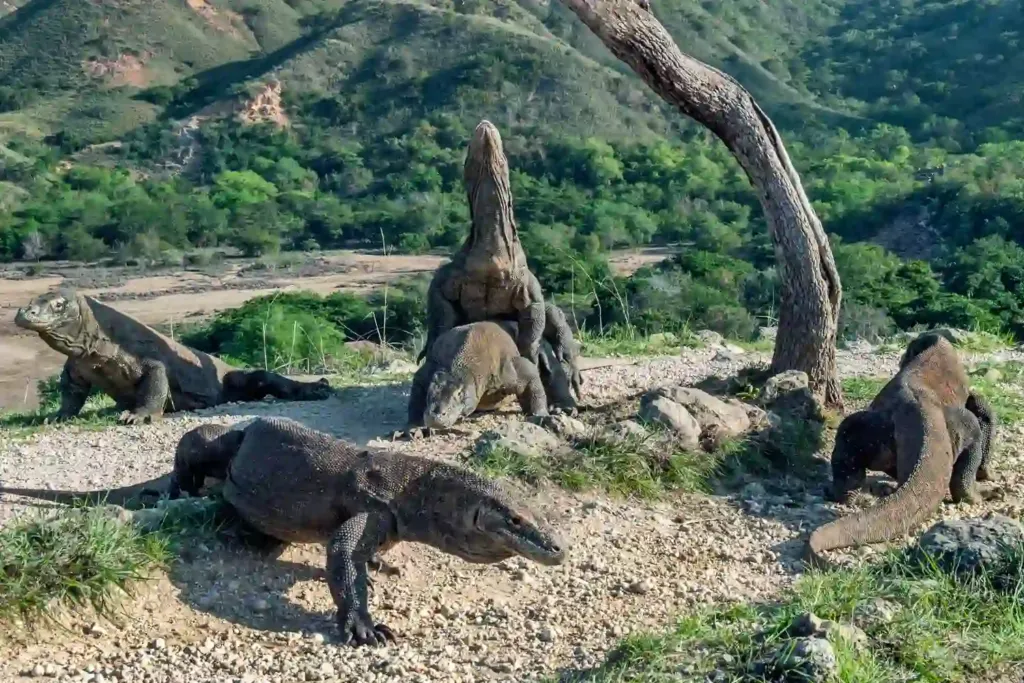
The greatest danger to a baby Komodo dragon is an adult Komodo dragon. Adults are cannibalistic and will eat smaller dragons, and on a small island there is nowhere on the ground to hide for long. The answer is up: the young climb into the trees, where heavy adults cannot follow.
Young Komodo dragons live in the trees during their first year to avoid predators, according to the San Diego Zoo Wildlife Alliance, citing field studies from the islands. Hatchlings and juveniles are good climbers with sharp claws, and only the very young are light enough to jump from branch to branch. As they grow heavier, they lose the ability to climb and spend more and more of their time on the ground.
Life in the canopy is not easy either. Other predators can still reach the branches, and a young dragon has to keep still, hide in the leaves and stay alert. But for a small lizard on an island ruled by giants, the trees are by far the safest place to be.
What baby Komodo dragons eat
In the trees, the young hunt small prey. According to the Smithsonian, they feed mainly on small lizards and insects, and also take snakes and birds. Insects, geckos and other small lizards are all within reach of a quick, hungry hatchling, and the trees are full of them.
As they grow, their diet grows with them. Larger juveniles take bigger prey, and by about five years old, a young dragon begins to hunt larger prey on the ground. Adults eat deer, wild pigs, water buffalo and carrion, as our guide to what Komodo dragons eat explains.
Even a hatchling has the tools of an adult in miniature: a forked tongue that tastes the air for scent, sharp serrated teeth and the venom glands described in our article on whether Komodo dragons are venomous. Small as they are, baby Komodo dragons are already efficient hunters.
Tricks for staying alive
Young dragons have a few clever ways of avoiding the adults. The Smithsonian notes that they often roll in fecal material, which masks their scent and puts off the large dragons that would otherwise eat them. It is not glamorous, but on an island where the adults hunt by smell, smelling bad is a very good defence.
Speed and caution help too. Juveniles are quick and agile, they stay close to cover, and they avoid the places where adults gather, such as a fresh carcass. When the large dragons feed, a smart youngster keeps its distance and waits for the leftovers.
Even so, the first years are the most dangerous part of a Komodo dragon’s life. Predators, hunger and the adults take many of the hatchlings, and only a small share of each year’s young live to become adults themselves.
That is why every surviving baby Komodo dragon matters so much to the population. A species that grows slowly, breeds late and loses most of its young depends on the few hatchlings that make it through, and on safe nesting areas where the next generation can begin. Protecting the hillsides and the megapode mounds where the eggs are buried is as important as protecting the adults on the beaches.
Growing up
Growth is steady once a young dragon survives its first year. By about five years old, it weighs around 25 kilograms and measures about two metres, according to the Smithsonian, and it now hunts larger prey on the ground. It still has to watch out for bigger dragons, especially around food, but most of the dangers of its early life are behind it.
Komodo dragons become sexually mature at five to seven years, and in zoos females usually first breed at seven to ten, according to the San Diego Zoo Wildlife Alliance. After that, they keep growing slowly for many years. In the wild, they can live for about 30 years, as our article on the Komodo dragon lifespan explains.
Born without a father
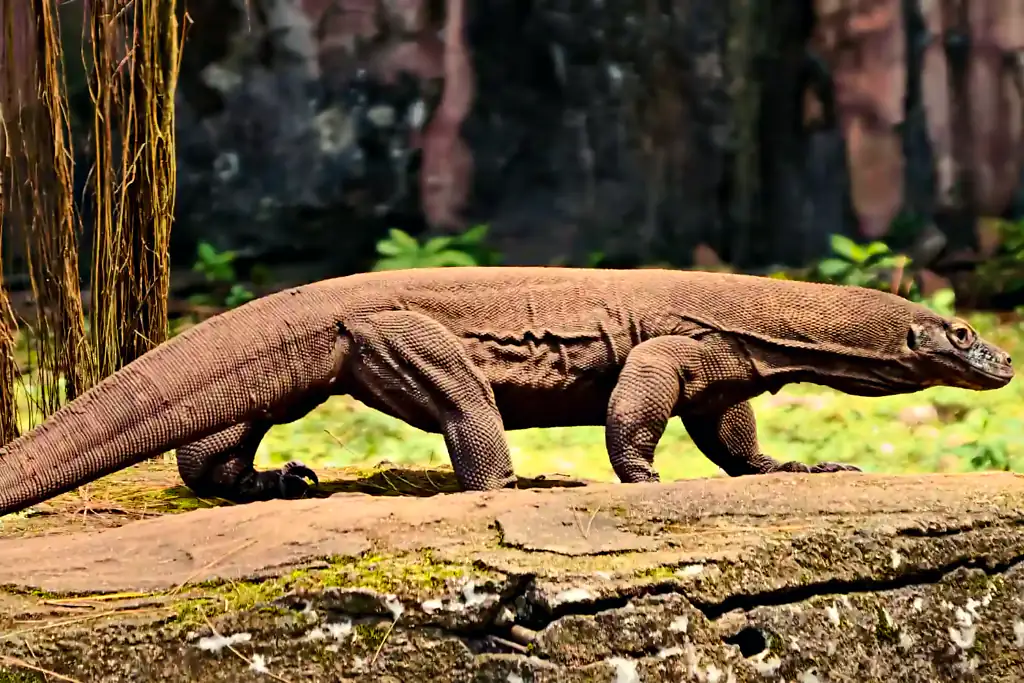
One of the most surprising discoveries about Komodo dragons came from two zoos in England. In December 2006, a study in the journal Nature showed that two females, Flora at Chester Zoo and Sungai at London Zoo, had produced young without mating with a male. Genetic tests confirmed that the mothers were the only parents, a process called parthenogenesis, or virgin birth.
The young of a virgin birth are always male. In Komodo dragons, females carry two different sex chromosomes and males carry two of the same kind, so an egg that develops from the mother’s genes alone can only produce a male. The study also found that a female can switch back to normal reproduction when a male is available.
Scientists think this ability may help a population start again, for example if a single female reaches an empty island. It does not mean that wild Komodo dragons often reproduce this way, but it shows how adaptable these ancient lizards are.
Hatchlings in zoos
Much of what we know about a baby Komodo dragon comes from zoos, where eggs can be watched from the day they are laid. In 1992, eggs from the Smithsonian’s National Zoo were incubated for about eight months in a laboratory at George Mason University in Virginia, and thirteen hatchlings came out within a few days of each other, as the university later recalled. They measured about 20 to 40 centimetres and weighed up to about 110 grams, small enough to hold in two hands.
Today, zoos around the world breed Komodo dragons as part of conservation programmes. Watching the young grow in safety, with no adults to fear, has taught scientists how fast hatchlings grow, what young dragons need to eat and how much the temperature of the nest matters. Those lessons help protect the wild population too, by showing how fragile the first months of a dragon’s life really are.
Can you see a baby Komodo dragon on a trip?
It is possible, but rare. Young dragons spend their time high in the trees and are very good at staying hidden, so most visitors only see the adults. A baby Komodo dragon is also far smaller than people imagine, about the length of a forearm, and its speckled skin blends with the bark and the leaves. Rangers know the islands well, though, and they sometimes spot a youngster on a branch near the trail, so keep your eyes on the trees as well as the ground on your walk.
Your chances are best on a ranger walk on Komodo or Rinca. Never try to approach or touch a young dragon, even a small one: it already has sharp teeth and venom, and larger dragons may not be far away. Our guides to Komodo Island and Rinca Island explain how the walks work.
Protecting the young starts with protecting the islands. The Komodo dragon has been listed as Endangered by the IUCN since 2021, mainly because of the expected effects of climate change on its habitat, as NPR reported. Following the park rules and staying on the trails helps keep the nesting areas undisturbed.

Our view
A baby Komodo dragon has one of the hardest starts in the animal world: months as an egg in a hillside, a lonely hatching, years hiding in the trees from its own kind. The few that make it become the giants you meet on a ranger walk. Komodo National Park was created in 1980 to protect them, and it has been a UNESCO World Heritage Site since 1991.
Every giant on the trail was once a hatchling in the trees, small, alone and very lucky.
Want to meet the dragons? Most liveaboard trips include a ranger walk on Komodo or Rinca. Compare the sharing trips with live prices and departures, and read more in our guide to the Komodo dragons.
Questions
How big is a baby Komodo dragon?
Less than 100 grams and about 40 centimetres long at hatching, according to the Smithsonian’s National Zoo.
Why do baby Komodo dragons live in trees?
To stay away from the adults, which eat smaller dragons and are too heavy to climb. The young live in the trees during their first year.
What do baby Komodo dragons eat?
Mainly insects and small lizards, plus snakes and birds. Their diet grows with them, and by five years old they hunt larger prey on the ground.
When do Komodo dragon eggs hatch?
Between February and May. The eggs are laid from July to early September and incubate for several months, depending on the heat and the moisture of the soil.
Do Komodo dragon mothers look after their young?
They guard the nest for months, but there is no care after hatching. The young are on their own from the first day.
Can a Komodo dragon have babies without a male?
Yes. In 2006, scientists confirmed virgin births in two zoo females in England. The young of a virgin birth are always male.
Will I see a baby Komodo dragon on a ranger walk?
Probably not, because the young hide in the trees, but rangers sometimes spot one. Look up into the branches as well as at the ground.







 Elbark Cruise
 Papiton Allo
 Semesta Voyages
 Sukha Sail 1