
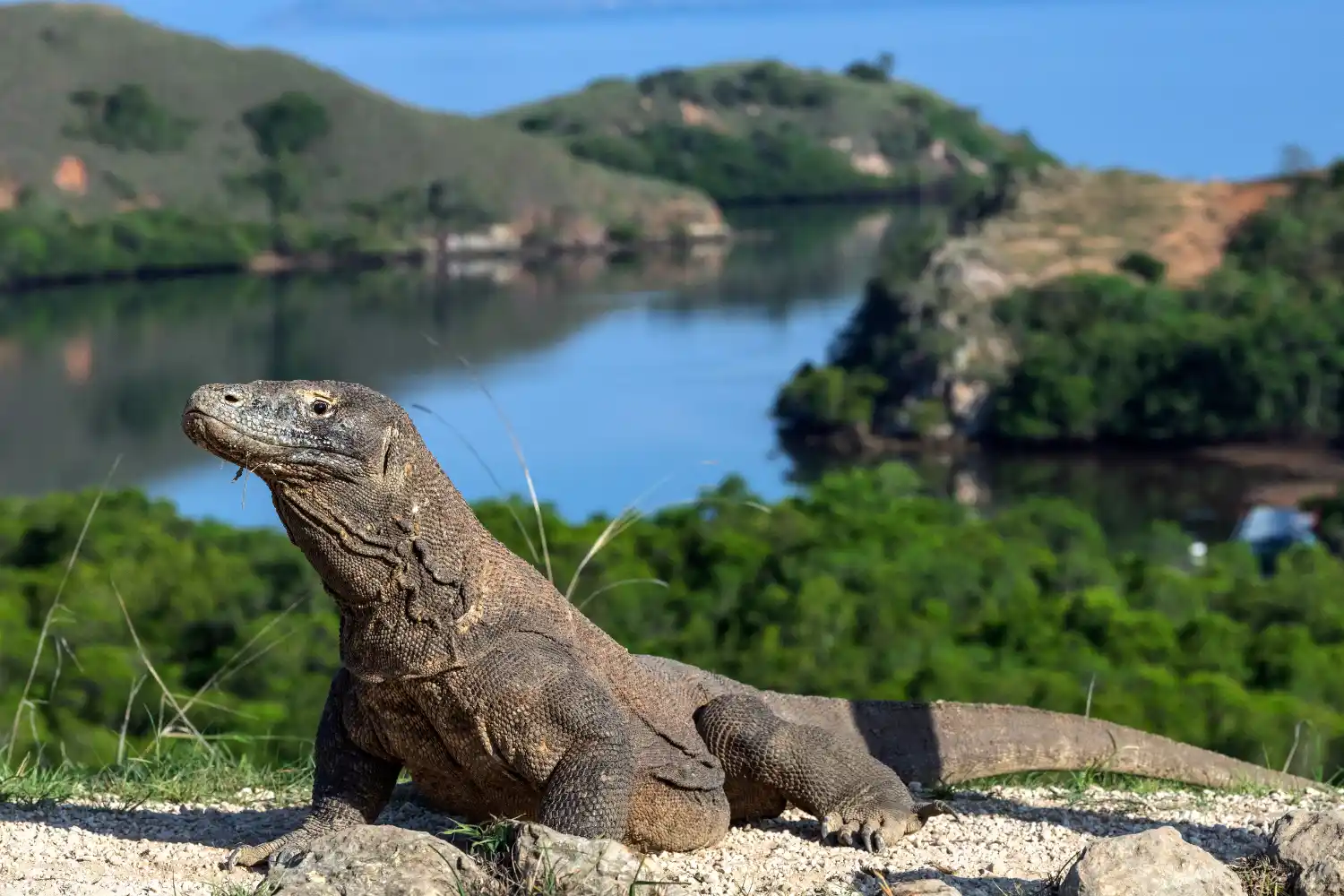
What is the Komodo dragon lifespan? In the wild, Komodo dragons live for about 30 years, and some males may live longer, while females usually live shorter lives. That long life begins as a small egg buried in a hillside, and it passes through years hidden in the trees before a dragon becomes the top predator of its island. This guide explains how long Komodo dragons live in the wild and in zoos, why males and females differ, how they grow from egg to adult, what shortens their lives and what is being done to protect them.
In short
- Komodo dragons live about 30 years in the wild, according to the Smithsonian’s National Zoo.
- Most males do not live past 30 to 40 years, and most females not beyond 20.
- Eggs take about nine months to hatch, and dragons mature at 5 to 7 years.
- The species has been Endangered on the IUCN Red List since 2021.
Komodo dragon lifespan at a glance
Here are the main figures from two of the most trusted sources on the species, the Smithsonian’s National Zoo and the San Diego Zoo Wildlife Alliance:
| Stage or setting | Figure |
|---|---|
| Lifespan in the wild | About 30 years (Smithsonian) |
| Wild males | Most do not live past 30 to 40 years (SDZWA) |
| Wild females | Most do not live beyond 20 years (SDZWA) |
| In zoos, median | About 20 years for males, 13 for females (SDZWA) |
| Egg to hatching | About 9 months (Smithsonian) |
| Sexual maturity | 5 to 7 years (SDZWA) |
The Smithsonian adds an important note: scientists are still studying how long Komodo dragons live. Long-lived animals in remote places are hard to follow from birth to death, so the figures are best estimates rather than exact limits.
You may also see other numbers online, some higher and some lower. Sources differ in what they measure, the average, the median or the longest known life, and in whether they describe dragons in the wild or in zoos. The figures above come from the zoos that study the species most closely, and they agree on the essentials.
How long do Komodo dragons live in the wild?
In their island home, Komodo dragons live for about 30 years. That is a long life for a reptile of any size, and it reflects the dragon’s place at the top of the food chain: once a dragon is fully grown, very few animals can threaten it. The main dangers come earlier, in the first years of life, and later from fights, injuries and hunger.
A slow metabolism helps too. Like other reptiles, a Komodo dragon does not burn energy to keep its body warm, so it needs far less food than a mammal of the same size and can survive long gaps between meals.
A long life also means a slow life. Komodo dragons grow slowly, mature late and lay one clutch of eggs at a time, which makes every adult valuable to the population. When you see a large adult on a ranger walk, you may be looking at an animal that hatched decades ago, before many of the visitors around you were born.
For most wild dragons, though, nobody knows the exact age. A dragon that hatched unseen in a hillside nest cannot be dated by looking at it, and size is only a rough guide, because growth depends on food, sex and luck. That is why the figures for the Komodo dragon lifespan come from long-term studies of known animals, in the wild and in zoos.

Males and females: a big difference
One of the most striking facts about the Komodo dragon lifespan is the gap between the sexes. According to the San Diego Zoo Wildlife Alliance, most males in the wild do not live past 30 to 40 years, while most females do not live beyond 20. In zoos, the median life expectancy is about 20 years for males and 13 for females.
Males are also much larger: up to about 3 metres and 136 kilograms, against about 2 metres and 70 kilograms for females, according to the same source. Scientists are still studying exactly why females live shorter lives, but producing and guarding eggs takes a great deal of a female’s energy, in a species where food can be scarce for long periods.
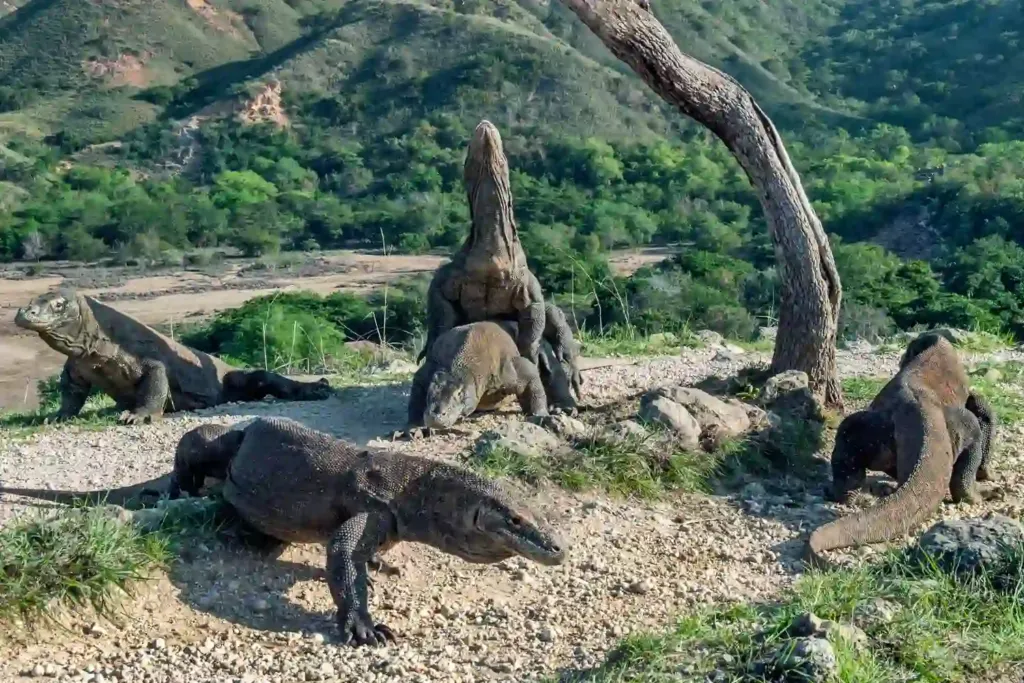
Male life has its own risks. Males compete with each other for females and for food, sometimes wrestling while standing up on their hind legs, and these fights can leave deep wounds. A large male that wins its battles may live a long life; a smaller one that loses them may not.
Komodo dragons in zoos
It may seem surprising that dragons in zoos have shorter median lives than the wild figures suggest. Medians and maximums measure different things: a median is the age that half of the animals reach, while the wild figures describe how long the longest-living dragons usually survive. Zoos also keep dragons in very different conditions from their dry island home, and they continue to learn how best to care for them.
Zoos play an important role for the species. Breeding programmes in zoos around the world help keep a healthy population outside Indonesia, and studies of dragons in human care have taught scientists much of what we know about their growth, their diet and their eggs.
Zoos also know exactly when each of their dragons hatched, which is rarely possible in the wild. That is why the zoo figures are given as medians, the age that half of the animals reach, and why they are one of the most reliable measures of the species’ lifespan, even if they describe life in very different surroundings.
From egg to hatchling
A Komodo dragon’s life starts in the ground. According to the Smithsonian, a female lays about 30 eggs in a hole dug on a hillside, or in the old nest mound of a megapode bird, such as the orange-footed scrubfowl, which builds large mounds of earth and leaves. The eggs then incubate for about nine months, a long wait during which they are at risk from predators and from the weather.
The choice of a megapode mound is clever. These birds build their nests from earth and leaves, and as the leaves inside slowly rot, they give off warmth, which helps keep the eggs at an even temperature. On a walk on Komodo or Rinca, the rangers often point out these mounds, and some may hold dragon eggs.
When they finally hatch, the young are tiny compared with their parents: they weigh less than 100 grams and are about 40 centimetres long. From the very first day they are on their own, with no care from their mother, and the first thing they need to do is find safety.
The first years in the trees
Safety, for a young dragon, means the trees. Adult Komodo dragons are cannibalistic and will eat smaller dragons, but they are too heavy to climb. So the young spend their first years mostly in the trees, where they hunt insects, small lizards, snakes and birds, and stay out of reach of the adults below.
They have another trick too. The Smithsonian notes that the young often roll in fecal material, which gives them a scent that the large dragons avoid. The first years are the most dangerous part of a dragon’s life, and only a small share of the hatchlings survive them.
Life in the trees shapes a young dragon in other ways too. It learns to hunt quick, small prey, to stay still and hidden, and to avoid the larger dragons below. By the time it comes down to the ground for good, it already has years of experience as a hunter, which it will need to survive among adults several times its size.
Growing up: from about five years
By about five years old, a young dragon weighs around 25 kilograms and begins to hunt larger prey on the ground, according to the Smithsonian. It is now too big for most of the dangers of its early life, although it still has to avoid larger dragons, especially around food.
Between five and seven years, dragons become sexually mature, according to the San Diego Zoo Wildlife Alliance. From then on, they keep growing slowly for many years. Adults usually measure two to three metres from nose to tail, and a typical wild adult weighs about 70 kilograms. Our article on how big a Komodo dragon gets covers their size and the records in detail.
How fast do Komodo dragons grow?
Slowly at first, then steadily for many years. A hatchling of less than 100 grams reaches around 25 kilograms by the age of five, according to the Smithsonian, which means it grows about two hundred and fifty times heavier in its first five years. After that, growth slows, but males in particular keep adding size and weight for a long time.
How fast a dragon grows depends on its food, and food on the islands is not always easy to find. A dragon that eats well in its early years grows faster and safer, while one that struggles stays small for longer, which keeps it at risk from larger dragons. In a sense, every meal in the first years buys a young dragon a little more time.
What shortens a dragon’s life?
Many things stand between a hatchling and old age. Eggs are lost to predators and to the weather, and the young are eaten by larger dragons. Adults are hurt in fights over food and mates, and an injured dragon may struggle to hunt. On small, dry islands, food can be scarce, and a long dry season can leave dragons hungry.
Inside the national park, protection removes many of the dangers that people bring. Hunting the dragons and their prey is forbidden, the forests and savannas are left to the animals, and the rangers keep an eye on both the dragons and the visitors. It is one of the reasons why the dragons of the park can live out their natural lives.
People are the bigger long-term threat. Outside the national park, on Flores, dragons lose their habitat and their prey to farming and settlements. And in 2021, the IUCN moved the Komodo dragon from Vulnerable to Endangered on its Red List, mainly because rising temperatures and sea levels are expected to shrink its habitat, as NPR reported.

Komodo dragons and other long-lived reptiles
Reptiles include some of the longest-lived animals on Earth. Giant tortoises can live for more than a century, and large crocodiles for several decades. Next to them, a life of about 30 years for a Komodo dragon may sound modest, but it is a long life for a lizard, and the Komodo dragon is by far the largest lizard alive.
What these animals share is a slow pace of life: they grow slowly, start breeding late and depend on adults surviving for many years. That makes them vulnerable when adults are lost, because a population of slow breeders takes a long time to recover. It is one of the reasons why protecting adult dragons, and their prey and habitat, matters so much.
Protecting a long-lived species
An animal that lives long and breeds slowly needs strong protection. The Komodo dragon is protected under Indonesian law and listed on Appendix I of CITES, which bans international trade, according to the San Diego Zoo Wildlife Alliance. Komodo National Park was created in 1980 to protect the dragons and their habitat, and it has been a UNESCO World Heritage Site since 1991.
Estimates of how many dragons remain vary. The San Diego Zoo Wildlife Alliance gives a wild population of about 3,500, while UNESCO’s description of the park mentions around 5,700. Inside the park, the population is considered stable and well protected, and every visitor who follows the rules helps keep it that way.
Seeing dragons of every age on a trip
On a ranger walk on Komodo or Rinca, you will mostly see adults, resting near the trails or walking slowly through the forest. Young dragons are much harder to spot, because they spend their time in the trees and keep away from the adults, but rangers sometimes point one out on a branch. Ask your ranger about the dragons you see: many know individual animals and can tell you about their lives.
Look for the signs of age and experience: the size of a big male, the scars from old fights, the slow, confident walk of an animal that has nothing to fear. A dragon resting by the path may look sleepy, but it has survived the egg, the trees and years of competition to be there.
Follow the simple rules: stay with the group and behind the ranger, keep several metres away even from a dragon that looks asleep, never feed or touch one, and move calmly. Our guides to Komodo Island and Rinca Island explain how the walks work.
Our view
The Komodo dragon lifespan is a story of patience: nine months in the egg, years hidden in the trees, and decades as the ruler of a small, dry island. Males can live for 30 to 40 years and females around 20, and every adult you meet on a ranger walk has survived a remarkable journey to get there. Seeing one in the wild, with a ranger beside you, is one of the great wildlife moments in Asia.
The dragon in front of you may have hatched before you were born. Treat it with the respect its age deserves.
Want to meet them? Most liveaboard trips include a ranger walk on Komodo or Rinca. Compare the sharing trips with live prices and departures, and read more in our guide to the Komodo dragons.
Questions
How long do Komodo dragons live?
About 30 years in the wild, according to the Smithsonian’s National Zoo. Most males do not live past 30 to 40 years, and most females not beyond 20.
Why do female Komodo dragons live shorter lives?
Scientists are still studying it. Producing and guarding eggs takes a great deal of energy in a species where food can be scarce.
How long do Komodo dragon eggs take to hatch?
About nine months. A female lays about 30 eggs in a hole on a hillside or in the old nest mound of a megapode bird.
When are Komodo dragons fully grown?
They become sexually mature at 5 to 7 years, and they keep growing slowly for many years after that.
Do Komodo dragons live longer in zoos?
Not usually. The median life expectancy in zoos is about 20 years for males and 13 for females, according to the San Diego Zoo Wildlife Alliance.
Are Komodo dragons endangered?
Yes. The IUCN moved them from Vulnerable to Endangered in 2021, mainly because of the expected effects of climate change on their habitat.
How fast do Komodo dragons grow?
From less than 100 grams at hatching to about 25 kilograms at five years old, according to the Smithsonian. Growth then slows, but continues for years.
Can a Komodo dragon live 50 years?
Some sources mention longer lives, but according to the San Diego Zoo Wildlife Alliance, most males in the wild do not live past 30 to 40 years.







 Elbark Cruise
 Papiton Allo
 Semesta Voyages
 Sukha Sail 1