Swimming with whale sharks in Saleh Bay is one of the great surprises of a trip between Lombok and Komodo. Early in the morning, the largest fish in the world come to the fishing platforms of the local fishermen, and the boats that sail this route stop to look for them before breakfast. It is a remarkable encounter, and one that needs care, because these gentle giants are endangered. This guide explains where Saleh Bay is, why the whale sharks are there, what scientists have learned about them, which boats stop there, when to go and how to swim with them responsibly.
In short
- Saleh Bay is on the north coast of Sumbawa, outside Komodo National Park, on the route between Lombok and Labuan Bajo.
- Whale sharks gather all year around the bagan, the lift-net fishing platforms, to feed on small fish.
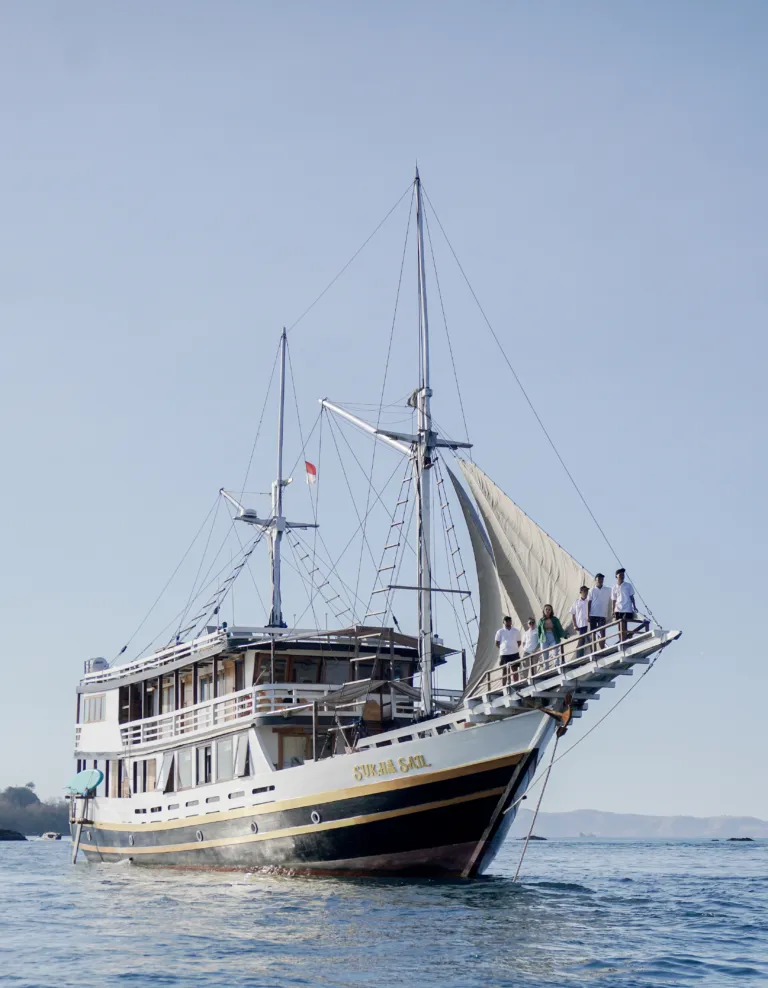
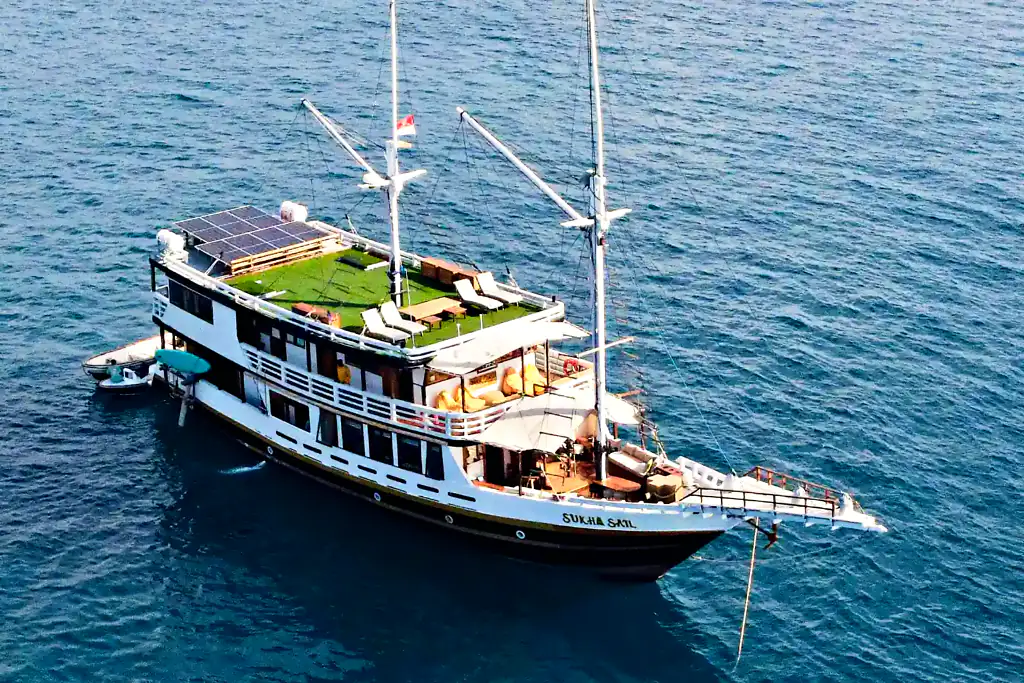
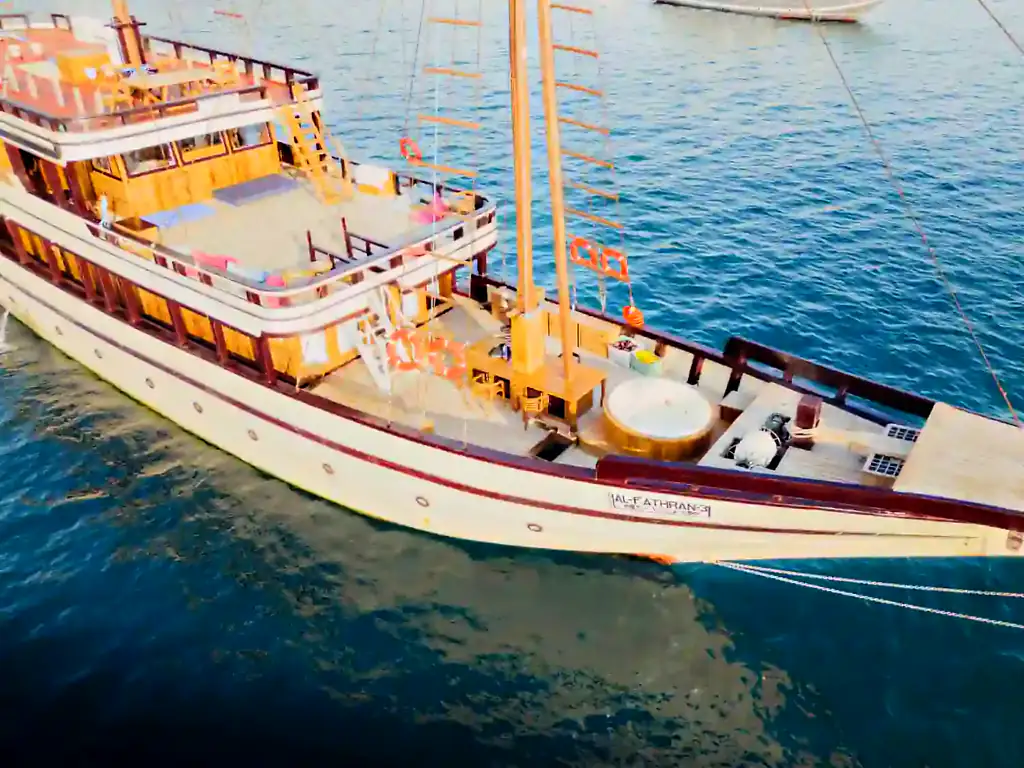
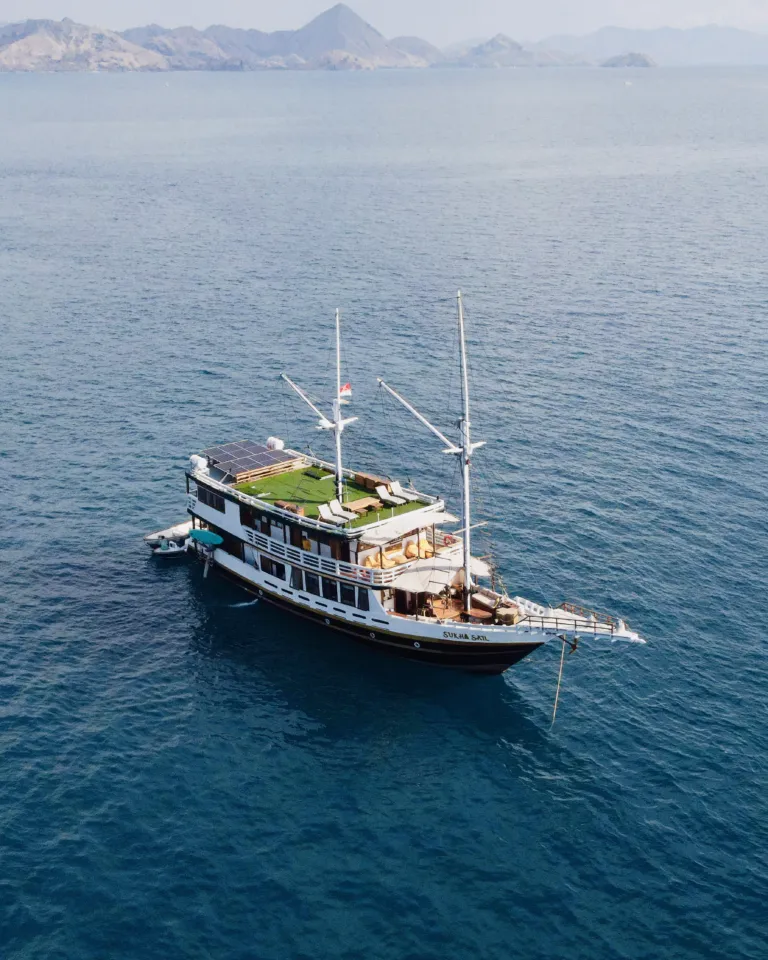
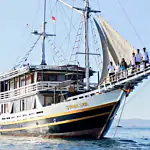
- On this site, Alfathran 3, Lady Grace and Sukha Sail 1 stop there, usually at dawn.
- Whale sharks are endangered and protected: keep your distance, never touch them and do not use flash.
Where is Saleh Bay?
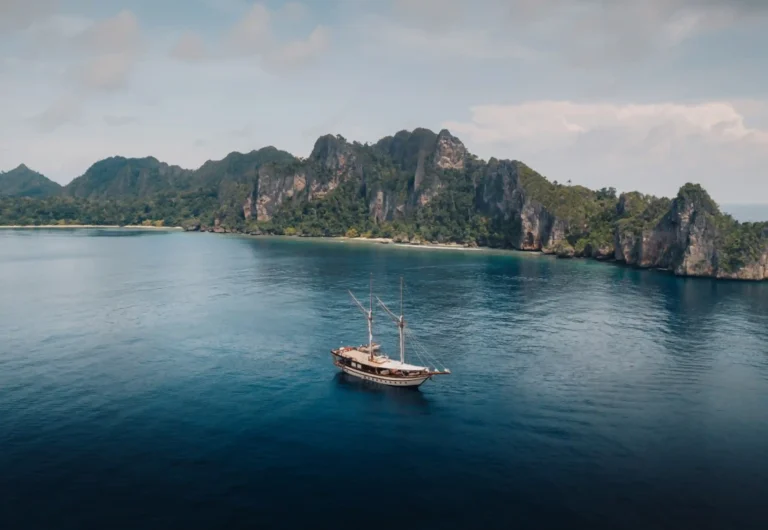
Saleh Bay, Teluk Saleh in Indonesian, is a large bay on the north coast of Sumbawa, the island between Lombok and Flores, in the province of West Nusa Tenggara. It lies outside Komodo National Park, roughly halfway along the sea route between Lombok and Labuan Bajo, which is why the boats that sail this route can stop there for a morning.
The bay is wide and sheltered, framed by the hills of Sumbawa, with the great volcano of Mount Tambora on the peninsula that borders it. Its eruption in 1815 was one of the largest in recorded history, and today its slopes are a quiet backdrop to the fishing platforms scattered across the calm water of the bay.
You do not see Saleh Bay on a normal trip from Labuan Bajo. It is part of the longer journeys between Lombok and Komodo, which take four days and three nights, and on some boats five days. Our guide on how to get from Bali to Komodo explains how the Lombok route fits into a trip.
Why whale sharks come to Saleh Bay
The answer is food. The bay is dotted with bagan, traditional lift-net fishing platforms that use lights at night to attract small fish. According to the Important Shark and Ray Areas assessment for Saleh Bay, whale sharks gather around these nets throughout the year, feeding on the small fish and shrimps the lights draw in, and they have often been seen sucking baitfish from the outside of the nets.
The same assessment notes that the sharks feed near the surface in the morning and then move to deeper water in the bay later in the day. That is why the boats arrive at dawn: early in the morning, when the fishermen bring in their nets, is the best chance to see whale sharks close to the surface.
Whale shark facts
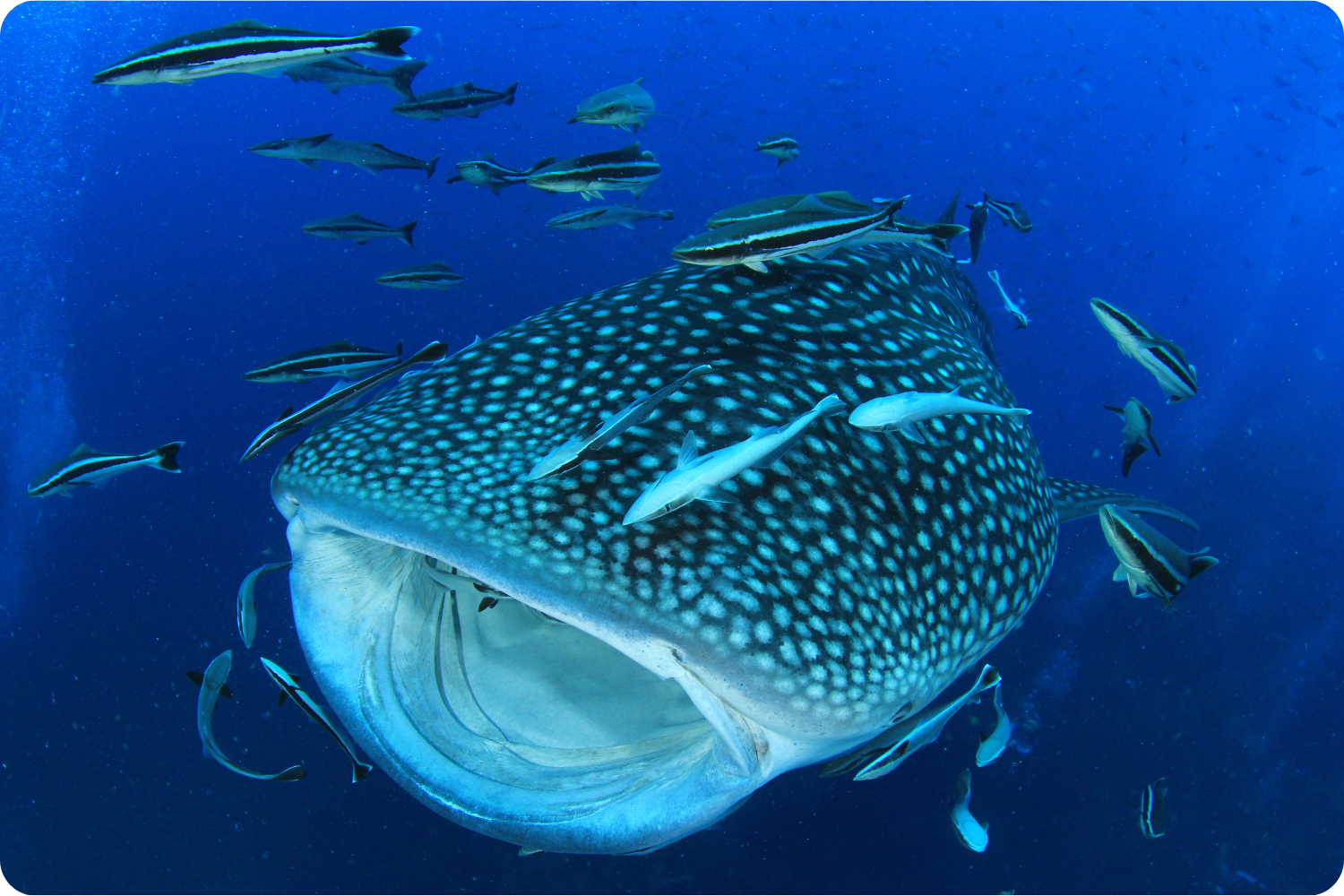
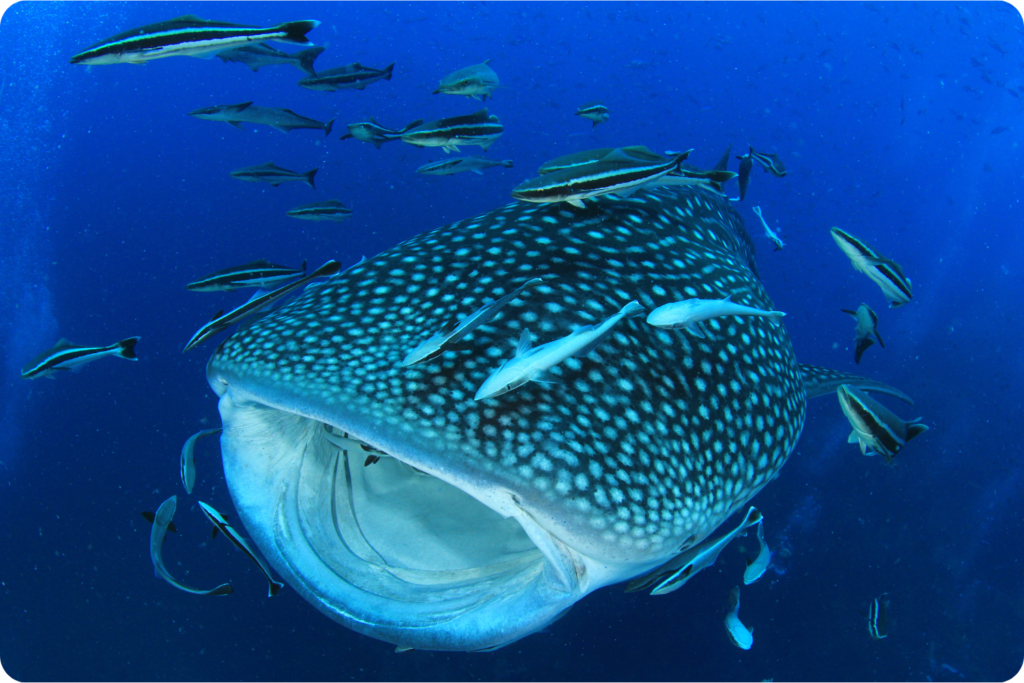
The whale shark is a shark, not a whale, and it is the largest fish in the sea. It lives in warm, tropical waters around the world and feeds by filtering huge amounts of water through its wide mouth, catching plankton, small fish and shrimps. It has no interest in people, and it moves slowly and calmly, which is what makes swimming beside one possible.
Each whale shark has its own pattern of white spots and stripes on its back and sides, as unique as a fingerprint. Researchers use photographs of this pattern, often taken by divers, snorkellers and fishers, to recognise individual sharks and follow them over the years. That is how scientists know how many different sharks visit Saleh Bay and how often they come back.
Young sharks and a possible nursery
Saleh Bay is one of the best-studied whale shark sites in Indonesia. The Important Shark and Ray Areas assessment reports that 108 individual whale sharks were identified there from photographs taken between 2017 and 2022. Almost all of them, 99%, were juveniles or young adults, with an average length of about five metres, and three in four were seen again in later years, which shows that many sharks return to the bay.
In 2024, the bay made scientific news. As Conservation International reported in December 2025, local fishers saw several very small whale sharks in August and September 2024, and one newborn, about four months old, was caught by accident in a bagan. They were the first newborn whale sharks recorded in Indonesia, and scientists now think Saleh Bay may be a nursery for the species, something that has never been confirmed anywhere in the world.
Which boats stop at Saleh Bay
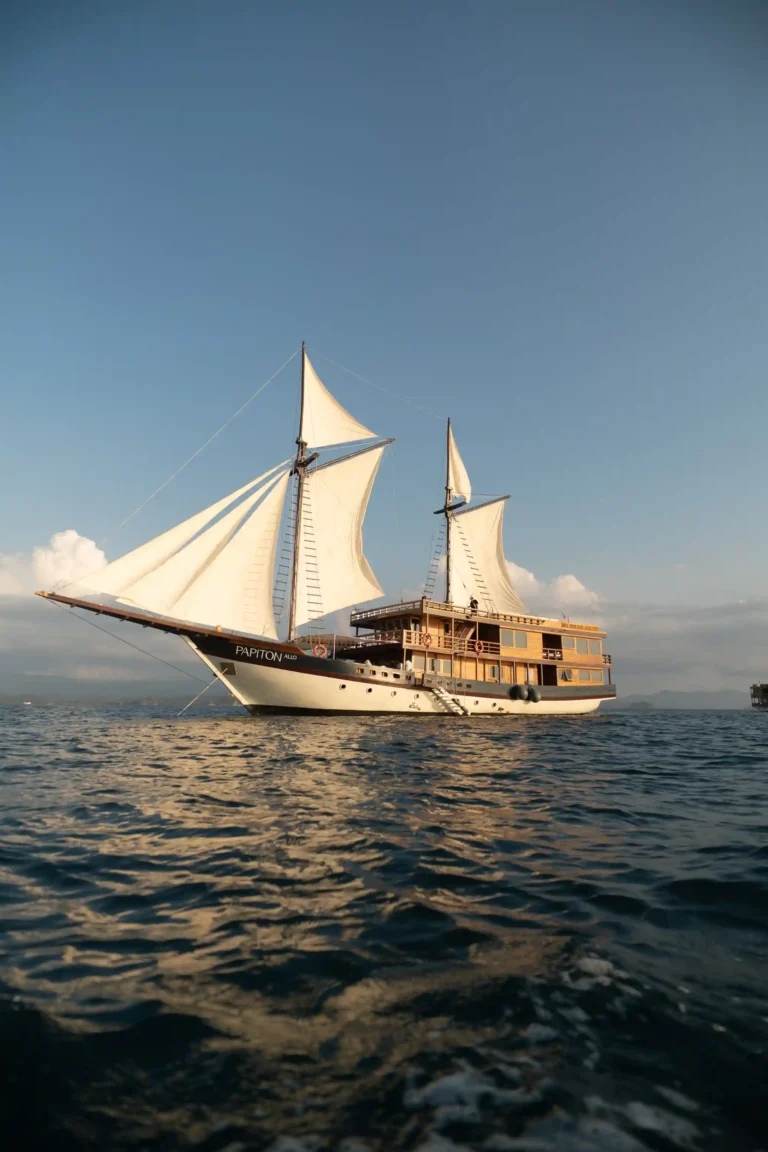
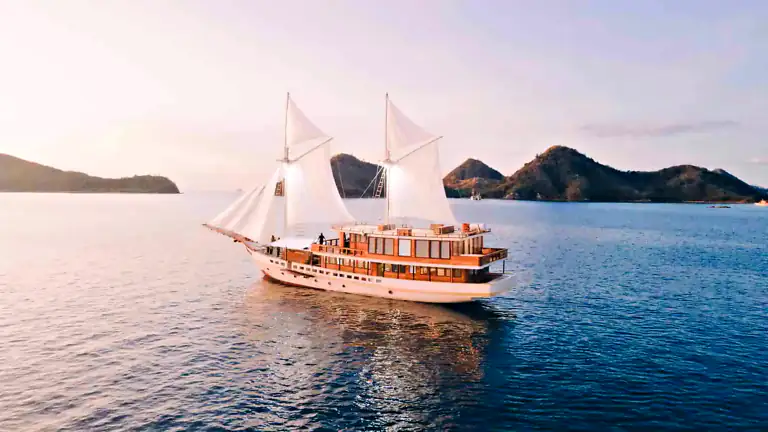
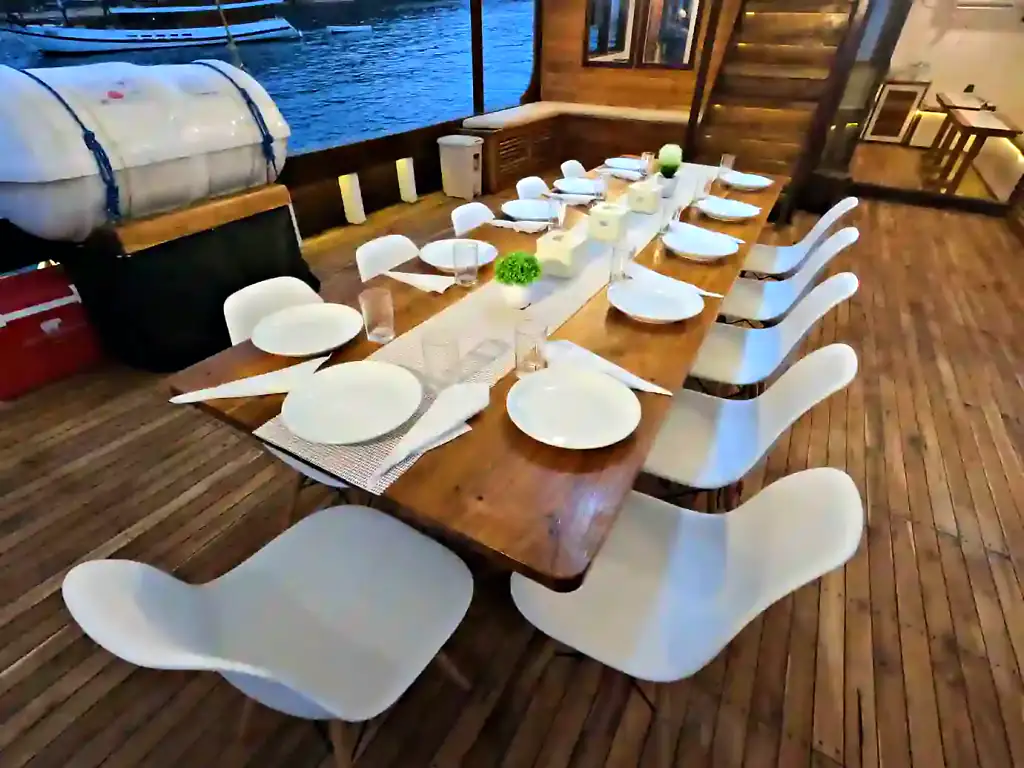
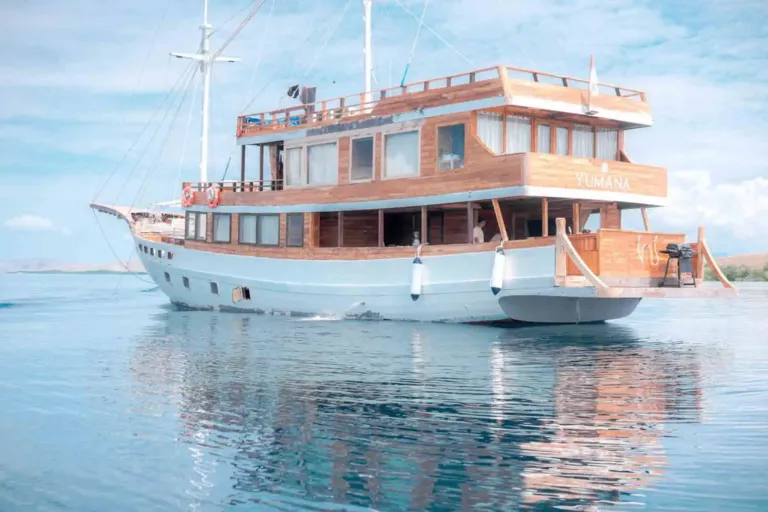
On this site, three boats sail between Lombok and Labuan Bajo and stop in Saleh Bay: Alfathran 3, Lady Grace and Sukha Sail 1. They sail in both directions, so you can start in Lombok and end in Labuan Bajo, or the other way round. The route also includes Kenawa Island, a small island with a grassy hill for the sunset or the sunrise, and the highlights of Komodo National Park, such as Padar, Pink Beach, Komodo Island and Manta Point.
The stops along Sumbawa differ by boat and direction. Lady Grace adds Satonda, with its crater lake, or Moyo Island and the Mata Jitu waterfall. Sukha Sail 1 adds Tambora Beach for a snorkel on one direction and Savana Beach on the other, and Alfathran 3 adds Savana Beach and, on its longer trips, Coral Beach. Each boat page shows its full itinerary.
What a whale shark morning looks like
The boat usually arrives in Saleh Bay the evening before and anchors for the night. On Lady Grace, for example, the wake-up call comes at 5:00, and by about 6:00 the boat is near the bagan, where the fishermen are bringing in their nets. The guide checks whether whale sharks are around, gives a short briefing on the rules, and you slip into the water from the tender with your mask and fins.
When the sharks are there, the encounter is unforgettable: a huge, spotted fish gliding slowly past, its wide mouth open as it feeds, so close that you can see the small fish swimming around it. After the swim comes breakfast on board and the next stop of the day. Whale sharks are wild animals, so sightings are never guaranteed, but the bay is known for regular encounters.
Remember that the bagan are working platforms and the fishermen are at work. Stay clear of the nets and the lines, follow the guide’s directions on where to swim, and give the fishermen space. Their platforms are the reason the sharks come, and their goodwill is what makes these encounters possible.
When to see whale sharks in Saleh Bay
Whale sharks have been recorded in Saleh Bay in every month of the year, with the largest number of observations in March and April, according to the Important Shark and Ray Areas assessment. That makes the end of the wet season and the start of the dry season a good time to try, although a trip at any time of year has a chance.
The sea matters too. The route between Lombok and Labuan Bajo includes open crossings along Sumbawa, which are generally calmer in the dry season, from April to November. In the wet season, from December to March, the crossings can be rougher and the crew may adjust the stops with the weather. Check the departures of each boat for the months you have in mind.
Whatever the month, the time of day matters most. The sharks are easiest to see in the early morning, close to the surface near the nets, which is why every boat on this route plans its Saleh Bay stop for sunrise. If the sharks are not there at first, the guide may wait a while or try another platform, but the plan for the rest of the day sets a limit.
How to swim with whale sharks responsibly
A whale shark is gentle, but it is a wild, endangered animal, and the way people behave around it matters. Indonesia’s guidelines for whale shark tourism ask visitors to keep their distance from the body and an even larger one from the tail, and never to touch, ride or feed the sharks. Listen to the guide’s briefing and follow these simple rules:
- Keep your distance, especially from the tail, which can strike hard without meaning to.
- Never touch, chase or ride a whale shark, and never block its path.
- Do not use flash when you take photos or videos.
- Enter the water calmly, without splashing, and swim slowly beside the shark.
- Stay with the group and leave the water when the guide asks.
Think about what you bring into the water too. Sunscreen washes off your skin and into the sea, so cover up with a long-sleeved swim shirt and use as little cream as you can, ideally a mineral one. Keep your hands to yourself and your fins below the surface, so you do not kick or splash near the animal.
Whale sharks are endangered and protected
The whale shark is the largest fish in the world, a filter feeder that eats some of the smallest animals in the sea. Despite its size, it is vulnerable: the IUCN listed the species as Endangered on its Red List in 2016, as numbers declined around the world. In Indonesia, whale sharks have been fully protected since 2013, under a decree of the Ministry of Marine Affairs and Fisheries, which bans catching and trading them.
Saleh Bay may become even more important. Konservasi Indonesia, the main partner of Conservation International in the country, is working with the government and the local fishers towards Indonesia’s first marine protected area designed around whale sharks in the bay. The fishers themselves play a big part: since 2018, many have shared their sightings, which is how the newborn sharks were found.
If you photograph a whale shark during your swim, your pictures can help too. A clear photo of the spots behind the gills can be used to identify the individual, and the guides and researchers who work in the bay are often glad to receive them.
Tourism and the welfare of the sharks
Whale shark tourism can help protect the sharks by giving them value alive, but only when it is done well. A study from IPB University found that tourism in Saleh Bay can harm the welfare of the sharks and that the rules are often broken, for example when too many people crowd around one animal or swim too close.
You can be part of the solution. Choose a calm, respectful encounter over the perfect selfie, keep your distance even if others do not, and tell the guide if you see something wrong. A short, quiet swim beside a whale shark is a far better memory than a crowded scramble, for you and for the shark. Our article on responsible travel in Komodo has more ways to protect the sea.
What to bring
Snorkelling equipment and life jackets are on board on most boats, but a mask that fits you well makes a big difference, so bring your own if you have one. A long-sleeved swim shirt protects you from the sun and means less sunscreen washing into the water. Bring an action camera or a phone in a waterproof case, with the flash turned off.
The morning starts early, so lay out your swimwear and gear the night before. If you are prone to seasickness, take your medicine before the crossings along Sumbawa. Our Komodo packing list covers everything else for the trip.
A light jacket is useful for the tender ride at dawn, when the air on the water can feel cool, and a towel and a dry layer waiting on the tender make the ride back to the boat much more comfortable.
Combining whale sharks with Komodo
The Lombok route is a way to see both: the whale sharks of Saleh Bay and the dragons, viewpoints and reefs of Komodo National Park, in four days and three nights. Lombok International Airport and Komodo Airport in Labuan Bajo both have direct flights from Bali and Jakarta, so many travellers fly into one island and out of the other, and spend a few days in Bali before or after.
On the Lombok side, the shuttle usually collects guests in Kuta, Senggigi or Bangsal in the morning and drives across the island to Kayangan Harbour, where the boat sets sail. The park fee is higher on these routes than on most trips from Labuan Bajo: for foreign guests, IDR 800.000 on Alfathran 3, IDR 1.000.000 on Sukha Sail 1 and IDR 1.200.000 on Lady Grace. Our guide to the trips of 4 days and 3 nights compares the boats.
If you start in Lombok, spend the night before the trip in Kuta or Senggigi, close to the pick-up points, so the early start is easy. And if you have time, a few days on the Gili islands or in Bali before the boat make a relaxed beginning to a journey that ends among the dragons of Komodo.
Our view
Seeing whale sharks in Saleh Bay is a privilege: a quiet morning swim beside the largest fish in the world, in a bay that may be one of its rare nurseries. Choose a boat on the Lombok route, follow the rules, keep your distance and let the sharks decide how close they come. Then sail on to Komodo National Park, a UNESCO World Heritage Site since 1991, for the dragons and the reefs.
Let the whale shark come to you. The best encounters are the calm ones.
Ready to plan the journey? Compare Alfathran 3, Lady Grace and Sukha Sail 1 on our Komodo liveaboard page, with their routes, live prices and departures.
Questions
Can I see whale sharks in Komodo National Park?
Not usually. On this site, the whale shark stop is in Saleh Bay, on the route between Lombok and Labuan Bajo, outside the park.
Are whale shark sightings guaranteed?
No. They are wild animals. Saleh Bay is known for regular encounters, but some mornings the sharks are not there.
What is the best month for whale sharks in Saleh Bay?
Whale sharks are seen all year, with the most observations in March and April, according to the Important Shark and Ray Areas assessment.
Are whale sharks dangerous?
No. They are filter feeders that eat tiny fish and shrimps. Keep your distance from the tail, which is powerful.
Can I touch a whale shark?
No. Whale sharks are endangered and protected in Indonesia, and touching them can harm their skin and stress them.
Which boats stop at Saleh Bay?
On this site, Alfathran 3, Lady Grace and Sukha Sail 1, on their trips between Lombok and Labuan Bajo.
Do I need to be a strong swimmer?
No. You snorkel at the surface, and life jackets are on board on most boats. Tell the guide if you are not confident in the water.
Can children swim with whale sharks?
Children who are comfortable in the water can often join with a life jacket and an adult, if the guide agrees. Ask the crew on the day.
 Elbark Cruise
 Papiton Allo
 Semesta Voyages
 Sukha Sail 1