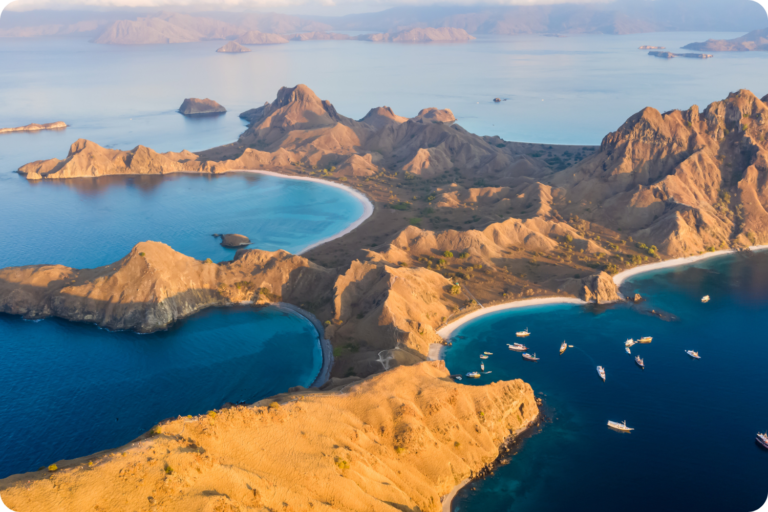
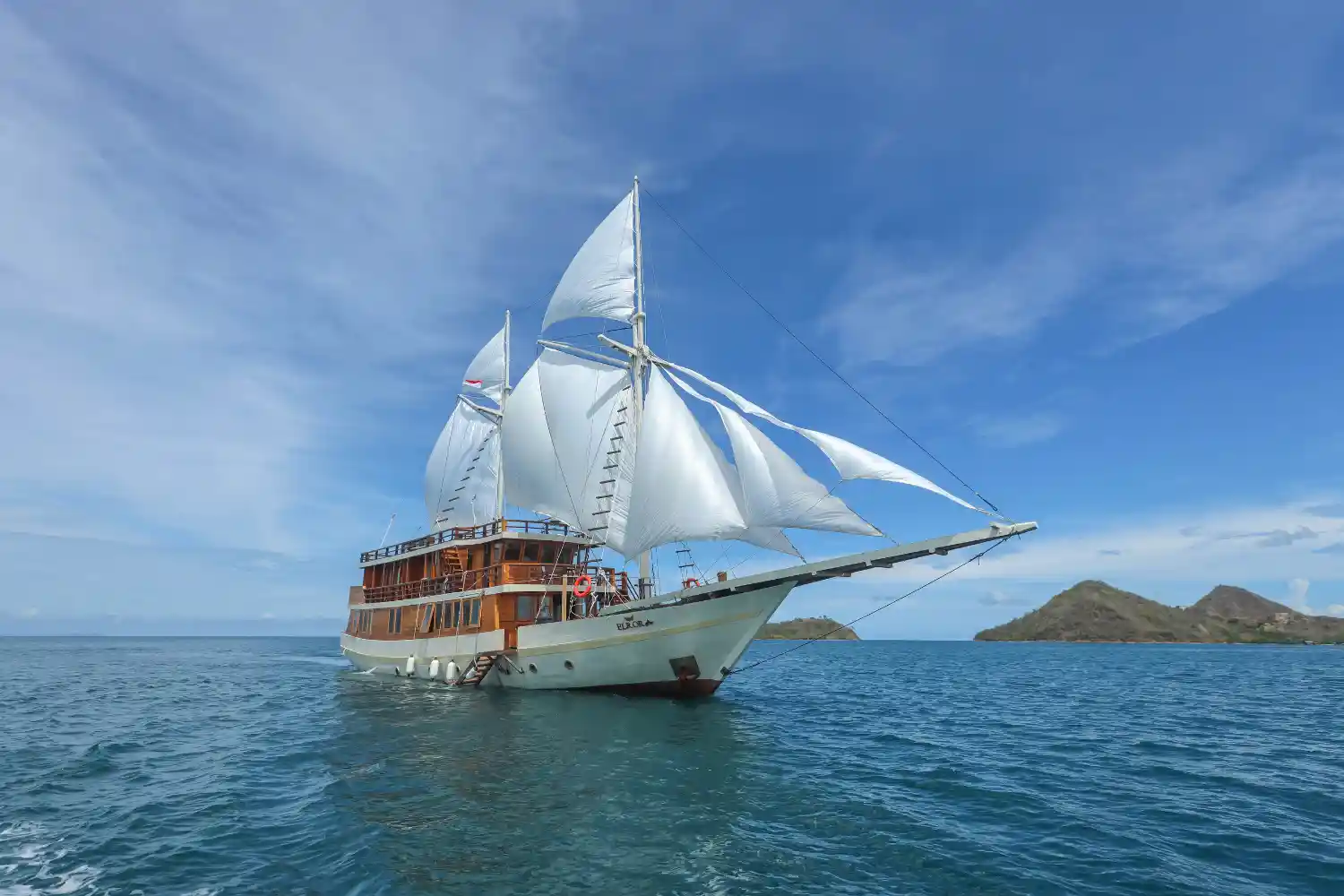
Look at almost any photo of Komodo National Park and you will see one: a wooden ship with a long, upswept bow, two tall masts and a deck full of people watching the sun go down. This is a phinisi boat, the traditional sailing ship of Indonesia, and today it is also the most common kind of liveaboard in Komodo. Here are seven things to know about the phinisi, from the beaches where it is built to the cabins where you sleep on board.
In short
- A phinisi, also written pinisi, is a wooden sailing ship from South Sulawesi, built by hand in boatyards such as Tana Beru and Bira.
- The art of building it has been on UNESCO’s list of the Intangible Cultural Heritage of Humanity since 2017.
- Most liveaboards in Komodo are modern phinisi, with engines, cabins and bathrooms, built in the same tradition.
1. The phinisi comes from South Sulawesi
The phinisi belongs to the seafaring peoples of South Sulawesi, the Bugis and the Makassarese, who have traded across the Indonesian archipelago for centuries. Their ships stand in a much older tradition of Austronesian boatbuilding and navigation, the same tradition that carried people across the islands of Southeast Asia and the Pacific.
For generations, these traders sailed with the monsoon winds, heading one way in one season and returning when the winds turned. Their ships carried timber, rice and everyday goods from island to island, and the skill of the sailors was valued as highly as the ships themselves.
Strictly speaking, the word pinisi describes the rig, the arrangement of masts and sails, of what sailors abroad called the Sulawesi schooner. Over time, it has come to mean the whole ship. Both spellings are correct: pinisi is the Indonesian form, while phinisi is the spelling you will see most often in Komodo and on liveaboard websites.
Today the main centres of phinisi boatbuilding are Tana Beru and Bira, in the regency of Bulukumba on the southern tip of Sulawesi, and Batu Licin. In these places, boatbuilding and sailing are far more than a trade: most families earn their living from the boats, and the boatyards are the heart of village life.
2. It is built by hand, on the beach
A phinisi is not built in a factory. It grows on the beach, in the shade of a simple roof, by the hands of a team of shipwrights. The master builder, known locally as the panrita lopi, works largely from experience rather than from drawings, and the knowledge of how to shape a hull is passed down from generation to generation, within families and from master to apprentice.
Traditionally, the work is marked by ceremonies at important moments, from the laying of the keel to the launch, when the finished hull is pushed down the beach and into the sea. Building a large phinisi by hand takes many months, and the families who order a new ship often follow its progress closely.
A walk along the beach at Tana Beru shows every stage of the work at once: a bare keel resting on blocks, a hull half covered in planks, and a finished ship waiting for its launch. The sound of hammers and saws carries from morning to evening, and the smell of fresh timber hangs over the whole village.
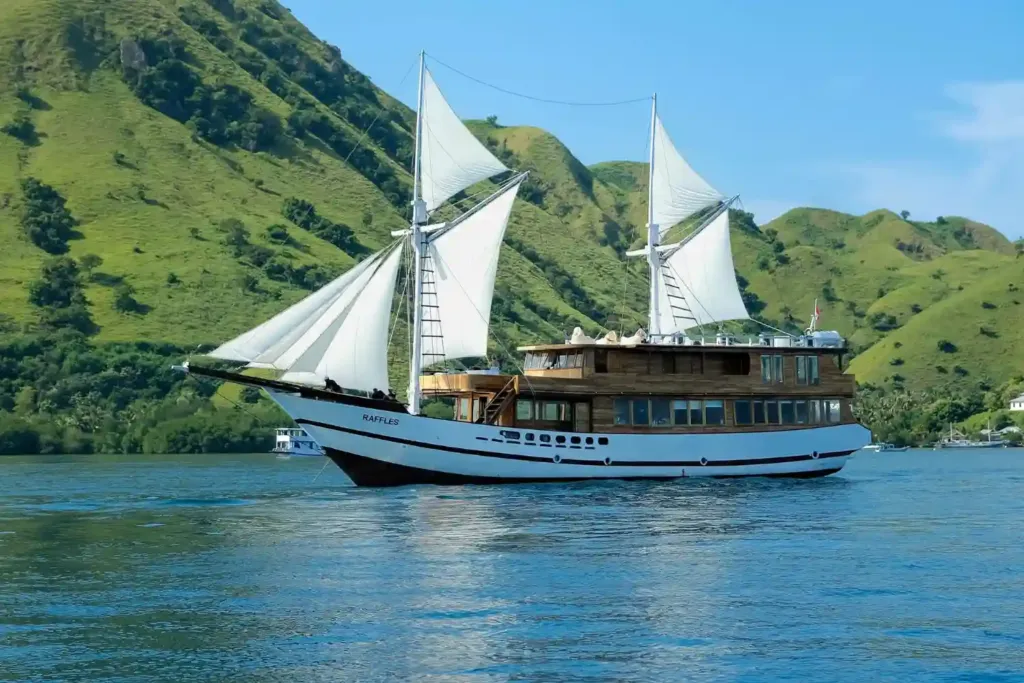
3. Ironwood, teak and a hull built shell first
Many phinisi are built of ironwood, known in Indonesia as ulin, and teak. Ironwood is heavy, hard and resistant to rot and to the sea, so it is used where strength matters most, while teak is often chosen for the decks and the finishes that guests see and touch every day.
The way the hull is put together is just as distinctive. Unlike most European ships, a phinisi is traditionally built shell first: the planks of the hull go up before the ribs that later hold them in place, and they are joined edge to edge with wooden dowels. The builders shape each plank by eye, so no two ships are exactly alike.
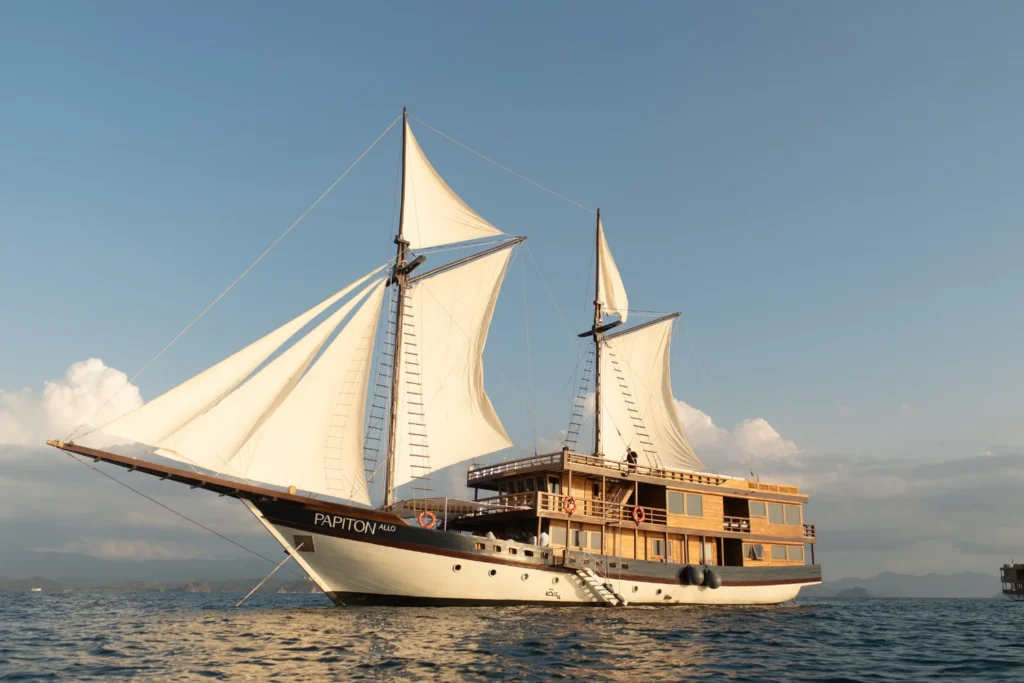
4. Two masts and seven sails
The classic phinisi rig has two masts and, in its traditional form, seven sails: several triangular sails at the bow, set from a long bowsprit, and the large sails on the two masts. It is this rig that gives the phinisi its elegant, unmistakable outline on the horizon.
On a modern liveaboard, the sails are more often a sight than a source of power. Most phinisi travel under engine, which keeps the trip on schedule, and the crew raise the sails when the wind, the weather and the route allow. When they do, it is one of the moments of the trip that guests remember best.
5. Building a phinisi is a UNESCO-listed craft
In 2017, UNESCO inscribed Pinisi, the art of boatbuilding in South Sulawesi, on its Representative List of the Intangible Cultural Heritage of Humanity. The listing does not protect a single ship. It recognises the knowledge, the skills and the communities behind the boats: the shipwrights, the sailors and the families who keep the tradition alive.
That makes a trip on a phinisi a small part of a living tradition. Komodo National Park itself is a UNESCO World Heritage Site, so a phinisi liveaboard in Komodo brings two kinds of heritage together: one made by people and one made by nature.
6. From cargo ship to liveaboard
For generations, phinisi carried cargo between the islands of the archipelago, and they were sailed by crews who knew the winds and currents of these seas by heart. Engines arrived in the twentieth century, and over the years many of the old cargo routes passed to steel ships.
The phinisi found a new life in travel. From Komodo to Raja Ampat, boats built in the same boatyards and in the same style now carry guests instead of cargo. The hull, the rig and the woodwork follow the tradition. Inside, a modern phinisi liveaboard has cabins, often with air conditioning and a private bathroom, a dining area and shaded decks for the long hours between the stops.
7. Every phinisi has its own character
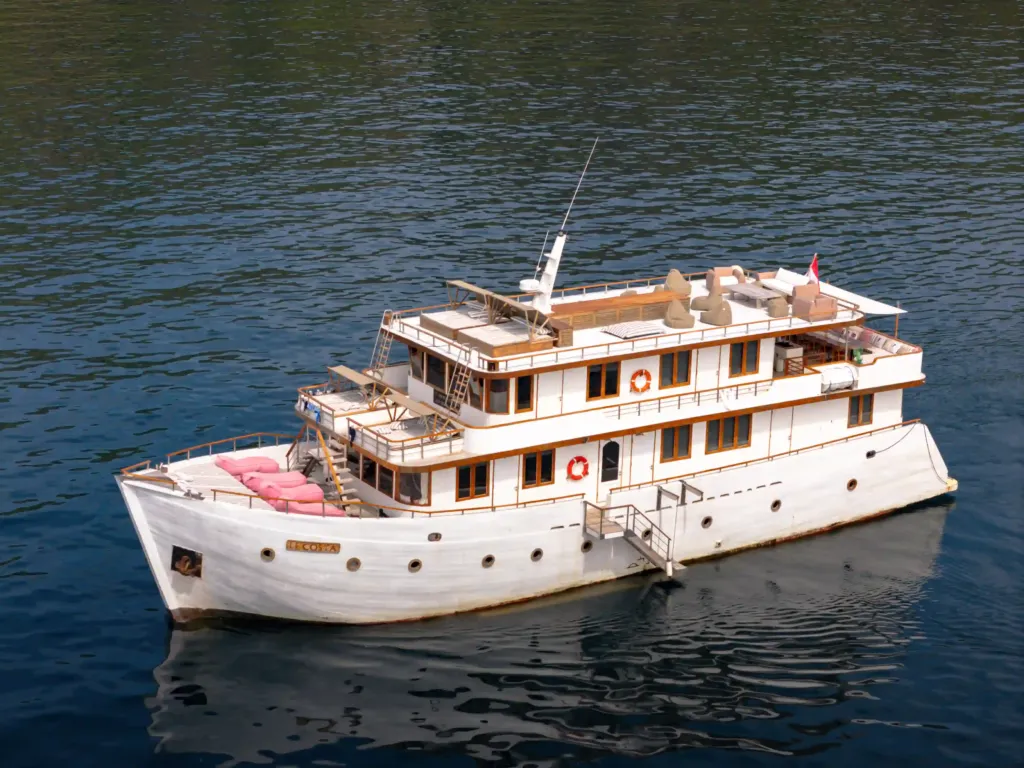
Because every phinisi is built by hand, no two are the same. The boats on our site range from just over 20 metres to around 40 metres in length, and from about a dozen guests to forty. Some are small and intimate, with only a few cabins. Others have more than ten cabins, several decks and room for large groups.
Each one has its own name, its own woodwork and its own crew. Elrora is a compact boat for 16 guests, Gammara takes 14, and Sukha Sail 2 is one of the largest at 40 metres. You can compare them all, with their cabins and live departures, on our page of Komodo liveaboards.
When you compare boats, look beyond the photos of the hull. The cabins, the bathrooms, the number of guests and the layout of the decks say more about how the trip will feel than the length of the ship. A boat with fewer guests is quieter, while a larger one gives you more space to find a corner of your own.
What it is like to sail on a phinisi
Life on a phinisi follows the light. Days often start early, with coffee on deck and a first stop before breakfast, and end at anchor in a quiet bay, with dinner under the stars. In between, the boat moves from island to island while you swim, snorkel, walk with the rangers or simply rest in the shade.
A phinisi is larger and steadier than a speedboat, and in the calm seas of the dry season the motion is gentle. The crew usually includes a captain, a cook, a guide and several deckhands, who look after the boat, the meals and the stops, and who know these waters well.
Meals are part of the rhythm of the day. On most boats the cook prepares Indonesian and international dishes in the galley, served at the long table on the main deck, with fruit, coffee and tea between the stops. Tell us about allergies or special diets when you book, so the crew can plan ahead.
Sleeping on board is part of the experience. Your cabin is your room for the trip, the deck is your living room, and the islands change outside the window every day. If you are new to liveaboards, our comparison of a Komodo liveaboard and a day trip explains how the days on board compare with a day on a speedboat.
Inside a modern phinisi
No two boats share the same layout, but most follow a familiar plan. These are the places where you will spend your days on board:
- The bow. The front of the ship, with the long bowsprit. On many boats it is the favourite spot for photos and for watching the islands come closer.
- The main deck. Usually home to the dining area, where meals are served at a long table, and to the galley, where the cook prepares them.
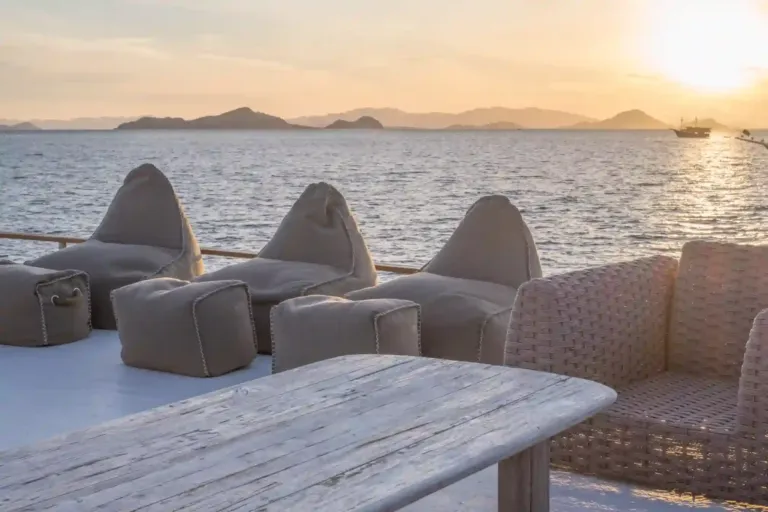
- The upper deck. Shaded or open to the sky, often with cushions, sun loungers or bean bags, and the best seat in the house at sunset.
- The cabins. Below deck or on the main deck, with beds, storage and, on many boats, air conditioning and a private bathroom.
- The wheelhouse. Where the captain steers and plans the route around the tides and the weather.
- The tender. A small boat that takes guests ashore and to the snorkelling spots while the ship stays at anchor.
Each boat page on our site shows its cabins, its decks and what is included, so you can see the layout before you book.
Life on board: a few simple customs
A wooden ship is a home as well as a vessel, and a few customs keep life on board easy for everyone:
- Shoes off. On most boats, guests go barefoot on deck and in the cabins, which keeps the wooden decks clean.
- Listen to the crew. The captain and the guide decide when to swim, when to go ashore and when to stay on board.
- Save water. Fresh water is carried or made on board, so keep showers short.
- Mind the rigging. Ask before you climb onto the bowsprit or the rigging, especially while the boat is moving.
- Leave no trace. Bring your rubbish back to the boat, and leave the beaches and the reefs as you found them.
Photographing a phinisi
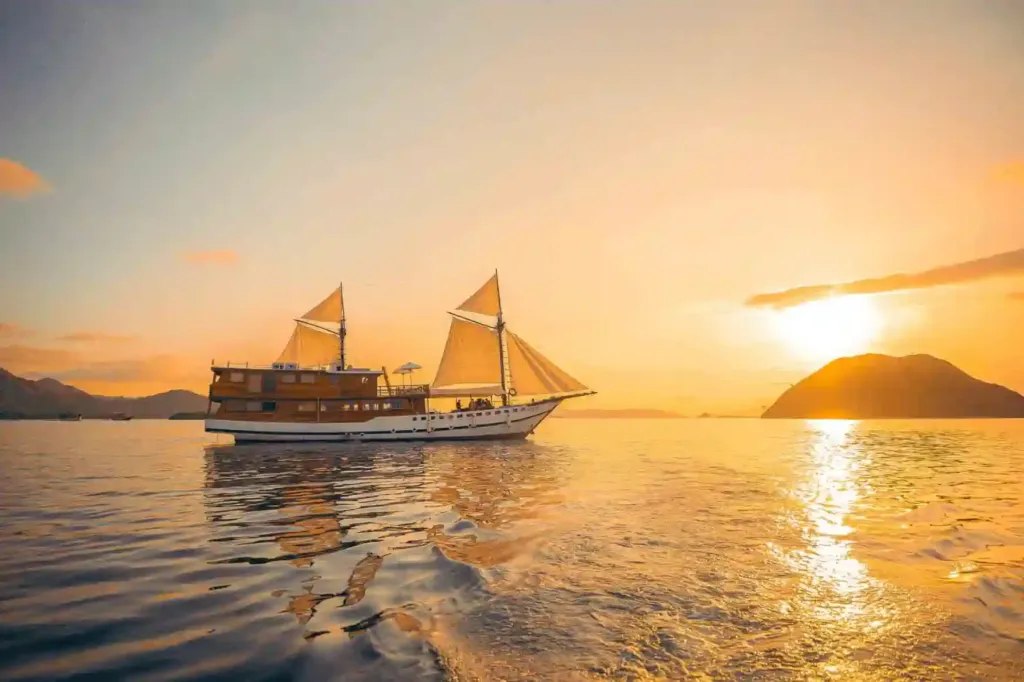
The best pictures of a wooden ship are taken from a little distance. Look back at your boat from the beach and from the viewpoints on the islands, or ask the crew whether you can ride along when the tender goes out. Early morning and late afternoon give the warmest light on the wood, and a calm bay at dusk turns the hull and the masts into a silhouette against the sky.
The phinisi boat, then and now
| Traditional phinisi | Phinisi liveaboard today | |
|---|---|---|
| Purpose | Carrying cargo between the islands | Carrying travellers between the islands of the parks |
| Power | Wind and sails | An engine, with the sails raised when conditions allow |
| Where it is built | Boatyards such as Tana Beru and Bira | The same boatyards, in the same tradition |
| Inside | Cargo holds and simple quarters for the crew | Cabins, bathrooms, a dining area and sun decks |
| On board | A crew of sailors | A captain, a cook, guides and deckhands |
How to choose a phinisi for your trip
With so many phinisi in Komodo, a few questions help you narrow the choice:
- Sharing or private? On a sharing trip you book a cabin and travel with other guests. With a private charter, the whole boat is yours.
- How many days? Most trips last 3 days and 2 nights, which covers the main stops of the park at a comfortable pace.
- Which cabin? Cabins differ in size, beds and bathrooms. Some take a third guest on an extra bed, and some are shared by the bed.
- Which size of boat? A smaller phinisi feels more personal, while a larger one has more decks and more room to spread out.
Our guide on how to choose a Komodo liveaboard goes through each of these questions in more detail, with tips on the budget and the season.
Our view
A phinisi is more than a way to get from one island to the next. It is a piece of Indonesian craftsmanship, shaped by hand on a beach in South Sulawesi and carried by a tradition of seafaring that is centuries old. Choosing a phinisi liveaboard means spending your days in Komodo on a boat that belongs to these seas.
Every phinisi starts as a pile of timber on a beach in South Sulawesi, and ends as a home on the water for the days you spend in Komodo.
Ready to choose yours? Browse the sharing trips with live cabin availability, or read our guide on how to book a Komodo liveaboard.
Questions
Is it phinisi or pinisi?
Both. Pinisi is the Indonesian spelling, used by UNESCO, while phinisi is the spelling you will see most often in Komodo and on liveaboard websites. They mean the same ship.
Where are phinisi boats built?
Mostly in South Sulawesi, in the boatyards of Tana Beru and Bira in the regency of Bulukumba. Batu Licin is another centre of the craft.
Do phinisi boats still use their sails?
Sometimes. Most phinisi liveaboards travel under engine, and the crew raise the sails when the wind, the weather and the route allow. If seeing the sails up matters to you, ask the crew whether the route allows it.
How long does it take to build a phinisi?
It depends on the size of the ship and the size of the team, but building a large phinisi by hand usually takes many months.
Is a phinisi comfortable for a first liveaboard?
Yes. A phinisi is larger and steadier than a speedboat, and many have cabins with air conditioning and a private bathroom. A trip of three days and two nights is a good first taste of life on board.
Can I charter a whole phinisi?
Yes. With a private charter, the whole boat and its crew are yours, and the trip follows your own dates and pace. It is a popular choice for families and groups of friends.
Why are these boats so popular in Komodo?
They are large enough to sleep on comfortably, steady in the water and beautiful to look at. Sleeping on board lets you spend the nights inside the park, which is the best way to see Komodo at sunrise and at sunset.
How is a phinisi different from a yacht?
A yacht is usually a modern boat built of fibreglass or steel to a set design. A phinisi is a wooden ship built by hand in the tradition of South Sulawesi, with its own hull shape, its own rig and a character that no two boats share.
Can I visit the boatyards where they are built?
Yes. The boatyards of Tana Beru and Bira, on the southern tip of Sulawesi, can be visited. They are several hours by road from Makassar, and a visit is a rare chance to see a ship take shape by hand.
What should I wear on board?
Light clothes, a swimsuit and something warm for the evening breeze on deck. Shoes come off on most boats, so sandals that slip on and off easily are the most practical choice for the stops on land.